
















Copyright: ©Author(s) 2026.
World J Gastrointest Oncol. Mar 15, 2026; 18(3): 116561
Published online Mar 15, 2026. doi: 10.4251/wjgo.v18.i3.116561
Published online Mar 15, 2026. doi: 10.4251/wjgo.v18.i3.116561
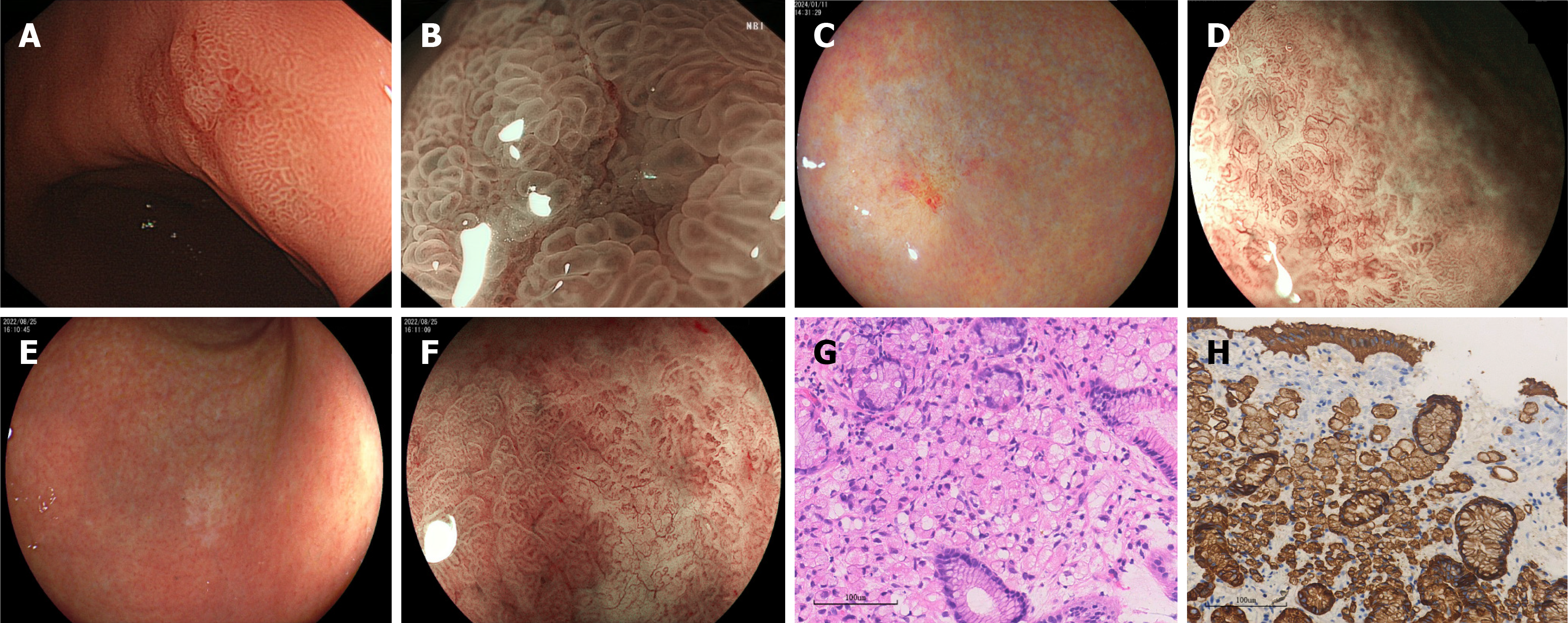
Figure 1 Endoscopic of early gastric signet ring cell carcinoma under white light, linked color imaging, narrow-band imaging, blue laser imaging, magnifying endoscopy and typical pathological images.
A: A 18 mm type 0-IIa + IIc lesion located at the lesser curvature of the lower gastric body showed reddish roughness with Helicobacter pylori (H. pylori) infection under white light; B: Narrow-band imaging-magnifying endoscopy showed the irregular microsurface pattern (MSP) and enlarged intervening part (IP) of lesion A; C: A 20 mm type 0-IIb lesion located at the greater curvature of the lower gastric body showed localized intermixed reddish-yellowish area and discoloration with H. pylori eradication under linked color imaging; D: Blue laser imaging-magnifying endoscopy (BLI-ME) showed the irregular MSP, irregular microvascular pattern (MVP) and enlarged IP of lesion C; E: A 10 mm type 0-IIb lesion located at the greater curvature of the lower gastric body showed discoloration with H. pylori-uninfected status under white light; F: BLI-ME showed the irregular MSP, irregular MVP and enlarged IP of lesion E; G: Microscopic appearance with hematoxylin-eosin staining (× 200); H: Confirmation of the diagnosis with immunohistochemical staining being positive for CK (× 200).
- Citation: Lu Q, Xiong F, Gu HC, Peng QZ, Yao J, Li DF, Huang BW, Wang LS. Clinical and endoscopic characteristics of early gastric signet ring cell carcinoma based on Helicobacter pylori infection status. World J Gastrointest Oncol 2026; 18(3): 116561
- URL: https://www.wjgnet.com/1948-5204/full/v18/i3/116561.htm
- DOI: https://dx.doi.org/10.4251/wjgo.v18.i3.116561