
















Copyright: ©Author(s) 2026.
World J Hepatol. Mar 27, 2026; 18(3): 115111
Published online Mar 27, 2026. doi: 10.4254/wjh.v18.i3.115111
Published online Mar 27, 2026. doi: 10.4254/wjh.v18.i3.115111
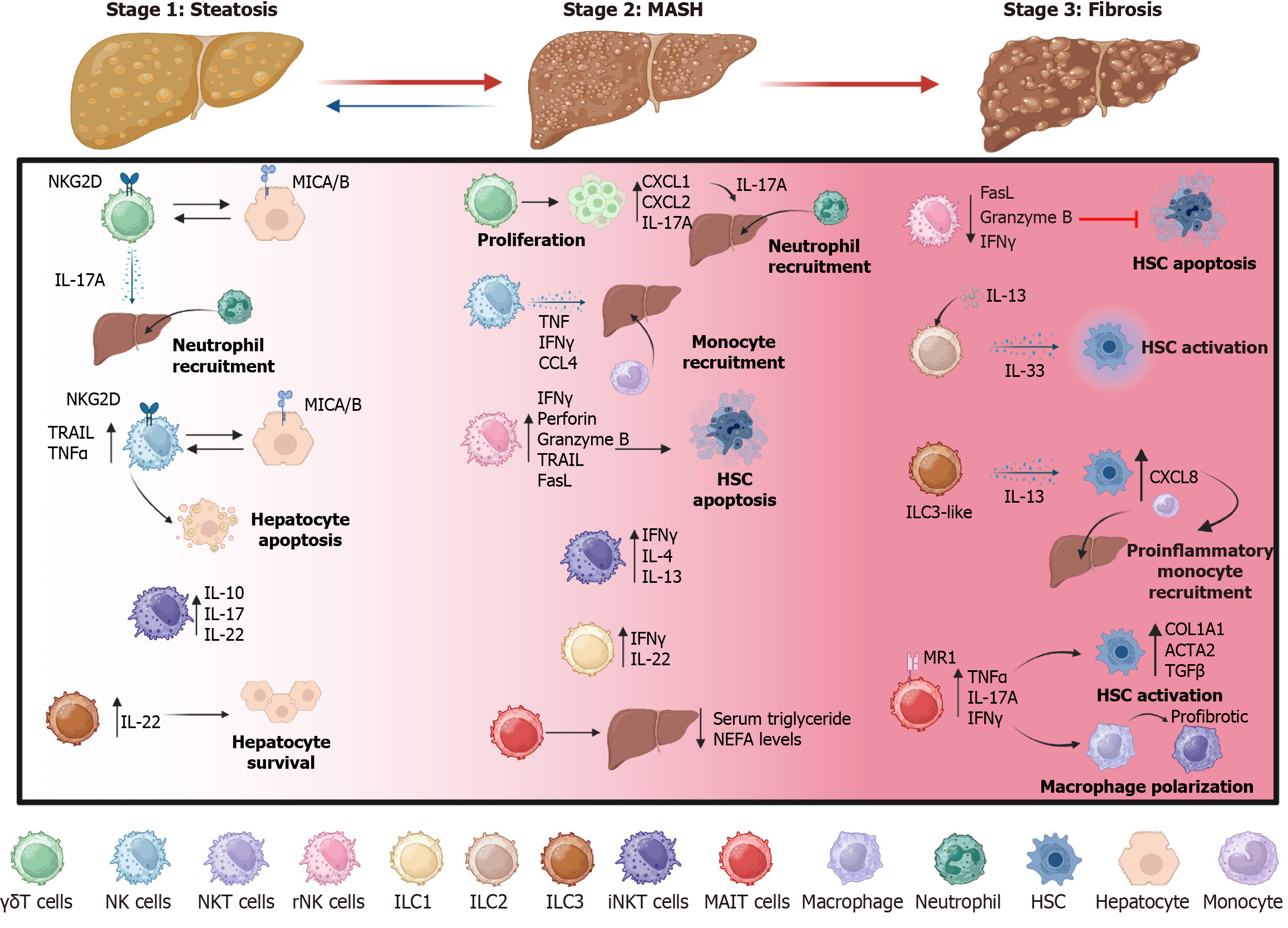
Figure 1 Immune mechanisms underlying the progression from steatosis to metabolic dysfunction-associated steatohepatitis and fibrosis.
During early metabolic dysfunction-associated steatotic liver disease, metabolic stress and lipid accumulation injure hepatocytes and upregulate stress ligands (major histocompatibility complex class I chain-related proteins A/B) and damage-associated molecular patterns, which activate gamma delta T (γδT) cells and natural killer (NK) cells through NK group 2 member D. γδT cells and innate lymphoid cell (ILC)-3 release interleukin (IL)-17A, licensing liver cells to produce C-X-C motif ligand 1 (CXCL1) and CXCL2 that recruit neutrophils and C-C motif chemokine ligand 2 that recruit monocytes. NK and γδT cells promote hepatocyte apoptosis via tumor necrosis factor alpha (TNF-α)-related apoptosis-inducing ligand, Fas ligand, and TNF-α, whereas IL-22 supports hepatocyte survival. In metabolic dysfunction-associated steatohepatitis, sustained inflammation is dominated by interferon-gamma, IL-13, and IL-17A drives monocyte recruitment and hepatic stellate cell (HSC) activation. The IL-33-ILC2-IL-13 pathway, IL-13-producing ILC3-like cells that induce CXCL8, mucosal-associated invariant T cell outputs via major histocompatibility complex-related molecule 1 (TNF-α, IL-17A, interferon-gamma), and invariant NKT cell cytokines further amplify HSC activation. Persistent immune activation polarizes macrophages toward pro-fibrotic phenotypes and increases HSC expression of collagen type I α1 chain, α-smooth muscle actin, and transforming growth factor beta. The schematic integrates crosstalk between lymphocyte subsets (γδT, NK, resident NK, invariant NKT, mucosal-associated invariant T, and ILCs) and hepatic cells (hepatocytes, macrophages, and HSCs) across metabolic dysfunction-associated steatotic liver disease stages. MASH: Metabolic dysfunction-associated steatohepatitis; NKG2D: Natural killer group 2 member D; MICA/B: Major histocompatibility complex class I chain-related proteins A/B; IL: Interleukin; TRAIL: Tumor necrosis factor alpha-related apoptosis-inducing ligand; TNF: Tumor necrosis factor; CXCL: C-X-C motif ligand; IFNγ: Interferon gamma; CCL: C-C motif chemokine ligand; HSC: Hepatic stellate cell; NEFA: Non-esterified fatty acids; FasL: Fas ligand; MR1: Major histocompatibility complex-related molecule 1; COL1A1: Collagen type I α1 chain; ACTA2: Α-smooth muscle actin; TGFβ: Transforming growth factor beta; γδT: Gamma delta T; NKT: Natural killer T cell; rNK: Resident natural killer.
- Citation: San Juan-Garcia CA, Escamilla RI, Cruz-Romero L, Hernandez-Silva CD, Fernandez-Quezada D, De la Cruz-Mosso U, Pereira-Suarez AL, Haramati J, Ramirez-Lopez IG, Macias-Barragan J, Montoya-Buelna M. From steatosis to inflammation: Innate lymphocytes as hidden orchestrators in metabolic dysfunction-associated steatotic liver disease. World J Hepatol 2026; 18(3): 115111
- URL: https://www.wjgnet.com/1948-5182/full/v18/i3/115111.htm
- DOI: https://dx.doi.org/10.4254/wjh.v18.i3.115111