
















Copyright: ©Author(s) 2026.
World J Clin Oncol. May 24, 2026; 17(5): 120600
Published online May 24, 2026. doi: 10.5306/wjco.v17.i5.120600
Published online May 24, 2026. doi: 10.5306/wjco.v17.i5.120600
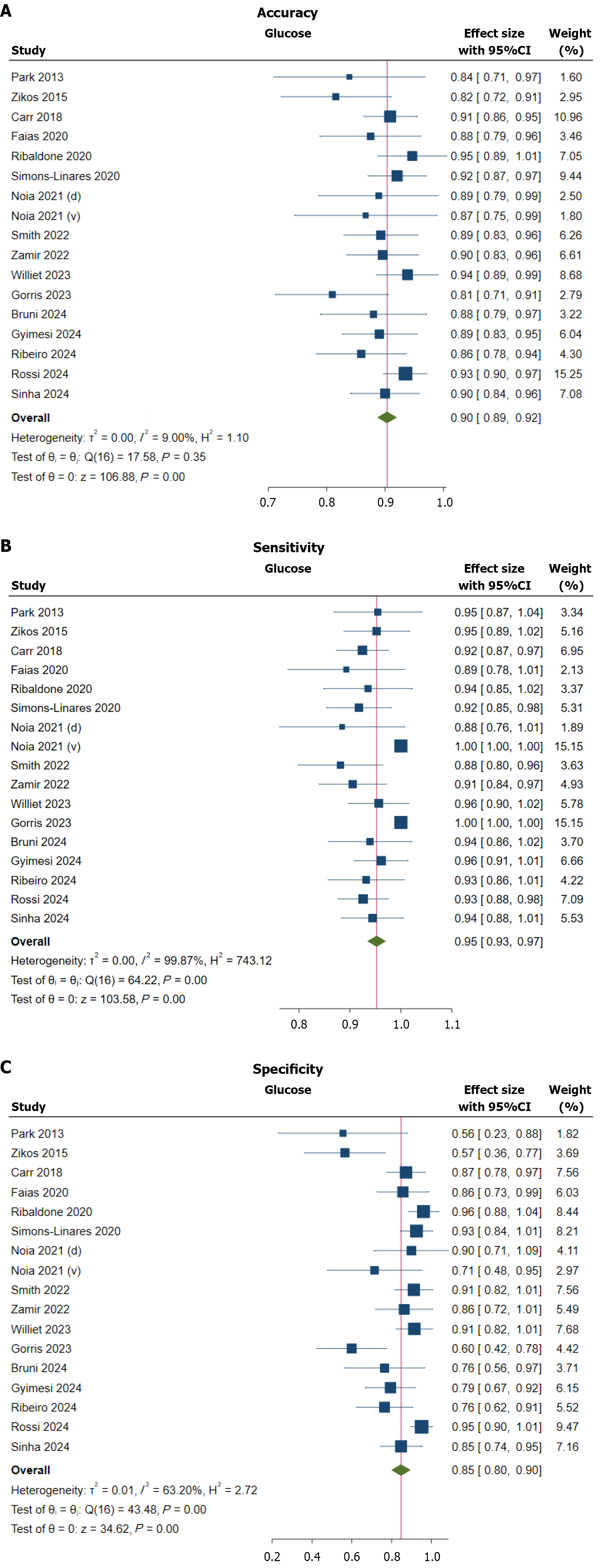
Figure 1 Forest plots showing pooled diagnostic performance of intracystic glucose.
A: Accuracy showing pooled estimates (diamonds) 0.90 (95%CI: 0.89-0.92, I2 = 9%); B: Sensitivity showing pooled estimates of 0.95 (95%CI: 0.93-0.97, I2 = 99.87%); C: Specificity showing pooled estimates of 0.85 (95%CI: 0.80-0.90, I2 = 63.20%). CI: Confidence interval.
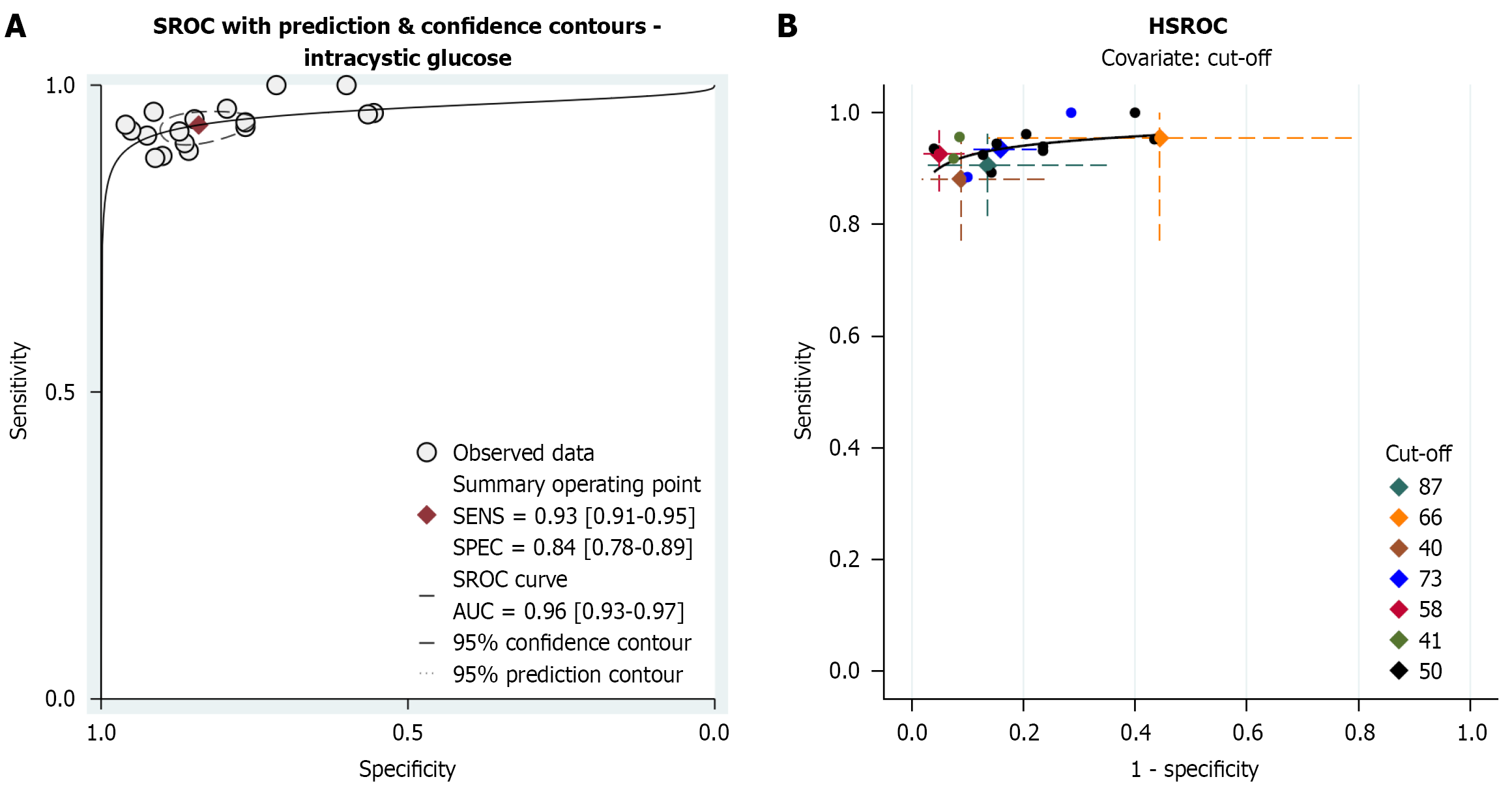
Figure 2 Bivariate and summary receiver operating characteristic analysis confirmed the strong diagnostic performance of intracystic glucose.
A: Bivariate model with summary receiver operating characteristic (SROC) curve for intracystic glucose (IG) in the diagnosis of mucinous pancreatic cysts. Results in the legend are reflected in the location of the summary point (in the upper-left quadrant of the receiver operating characteristic space), and in the shape of the 95% confidence and prediction regions, which were narrow, indicating a minimal threshold effect and consistent results across studies; B: Hierarchical summary receiver operating characteristic (HSROC) considering cut-off thresholds for each study as covariate: Colored dots represent individual studies, with different colors indicating the IG cut-off used in each study (see legend). Dashed horizontal and vertical lines indicate the 95%CI for sensitivity and 1 - specificity, respectively. The solid black curve represents the HSROC curve fitted across all cut-offs. SROC: Summary receiver operating characteristic; IG: Intracystic glucose; HSROC: Hierarchical summary receiver operating characteristic.
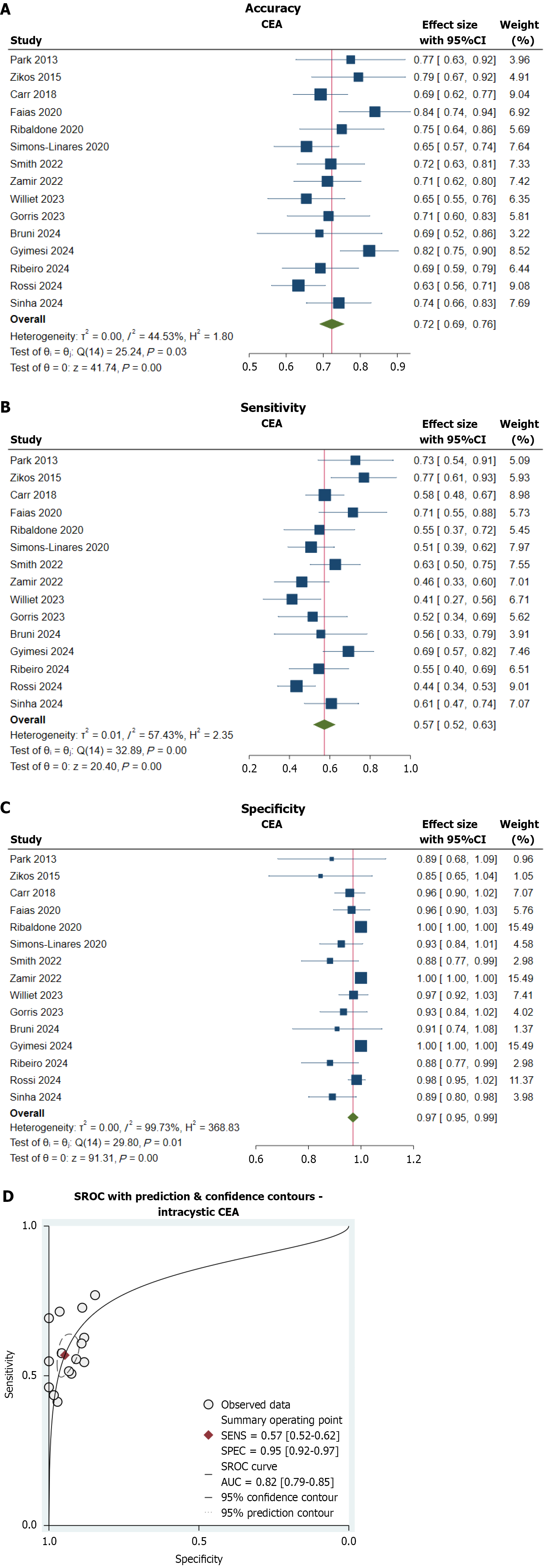
Figure 3 Forest plots showing pooled diagnostic performance of carcinoembryonic antigen.
A: Accuracy, with pooled estimate (diamond) 0.72 (95%CI: 0.69-0.76, I² = 44.53%); B: Sensitivity, with pooled estimate 057 (95%CI: 0.52-0.63, I² = 57.43%); C: Specificity, with pooled estimate 097 (95%CI: 0.95-0.99, I² = 79.73%); D: Summary receiver operating characteristic curve for carcinoembryonic antigen in the diagnosis of mucinous pancreatic cysts. Results showed in the legend are supported by the distribution of the plots, and the confidence region was narrow, but the prediction region was broader along the sensitivity axis, suggesting variability in diagnostic performance across studies. CEA: Carcinoembryonic antigen; CI: Confidence interval.
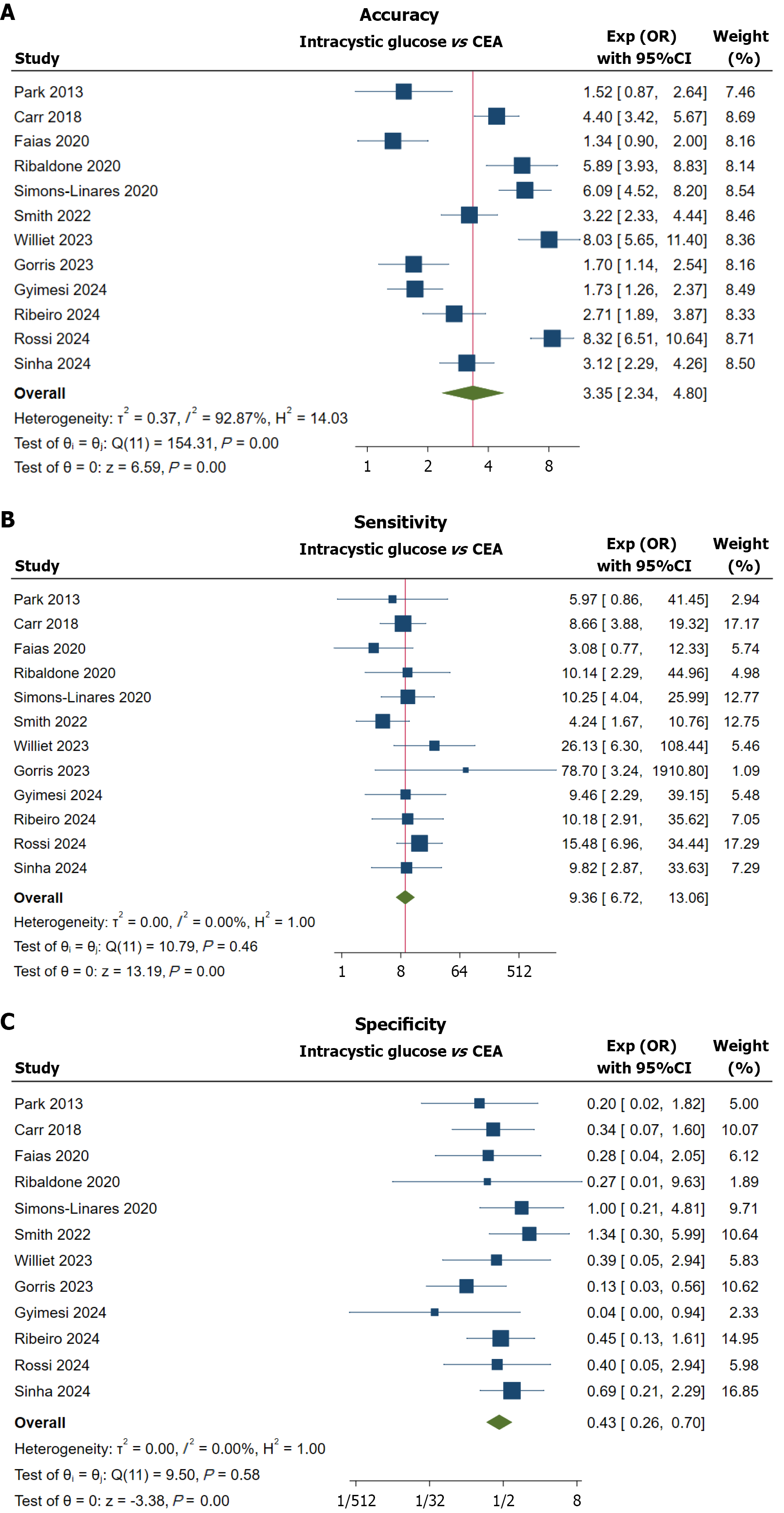
Figure 4 Forest plots showing the comparative diagnostic performance (pooled odds ratio) of intracystic glucose vs carcinoembryonic antigen.
A: Accuracy, with pooled odds ratio (OR): 3.35 (95%CI: 2.34-4.80, I² = 92.87%); B: Sensitivity, with pooled OR: 9.36 (95%CI: 6.72-13.06, I² = 0%); C: Specificity, with pooled OR: 0.43 (95%CI: 0.26-0.70, I² = 0%). CEA: Carcinoembryonic antigen; CI: Confidence interval; OR: Odds ratio.
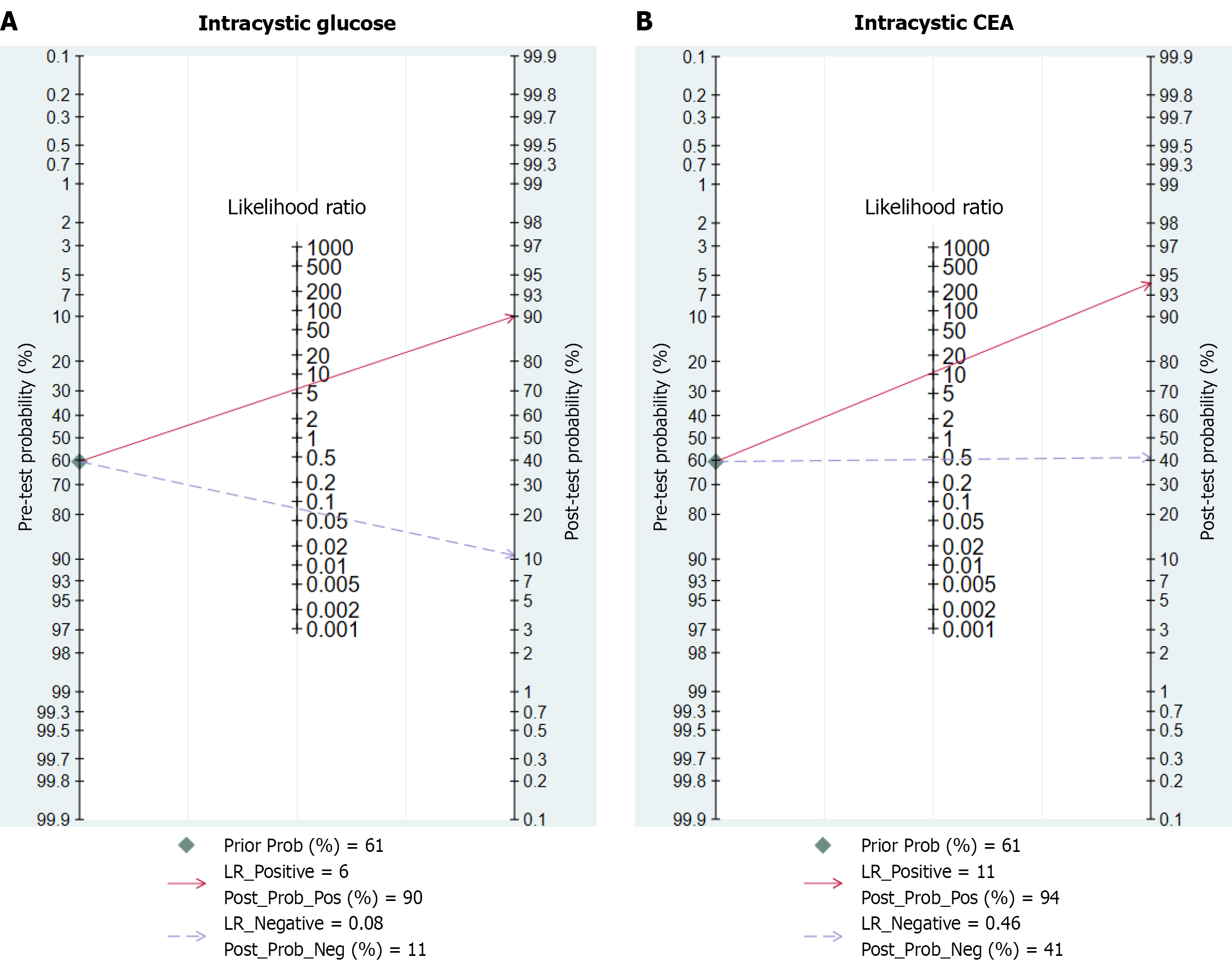
Figure 5 Fagan plots.
A and B: Fagan nomograms illustrating the impact of intracystic glucose (IG) (A) and carcinoembryonic antigen (CEA) (B) on post-test probability, assuming a pre-test probability of 60.6%. The solid red arrows represent the shift in probability after a positive test, while dashed grey arrows represent the shift after a negative test, increasing post-test probability to 90% and 94% for positive IG and CEA, respectively, and reducing it to 11% and 41% for negative results. The legend reports the assumed prior probability (Prior Prob), the positive and negative likelihood ratios (LR_Positive and LR_Negative), and the corresponding post-test probabilities for positive and negative test results (Post_Prob_Pos and Post_Prob_Neg). CEA: Carcinoembryonic antigen.
- Citation: Rizzo GEM, Infantino G, Marchegiani G, Machicado JD, Del Chiaro M, Tarantino I, Rossi G, Arcidiacono PG, Vanella G, Guilabert L, Nikolić S, Capurso G. Intracystic glucose is superior to carcinoembryonic antigen in diagnosing mucinous pancreatic cysts in genomic era: Systematic review and meta-analysis. World J Clin Oncol 2026; 17(5): 120600
- URL: https://www.wjgnet.com/2218-4333/full/v17/i5/120600.htm
- DOI: https://dx.doi.org/10.5306/wjco.v17.i5.120600