
















©The Author(s) 2026.
World J Cardiol. Feb 26, 2026; 18(2): 110803
Published online Feb 26, 2026. doi: 10.4330/wjc.v18.i2.110803
Published online Feb 26, 2026. doi: 10.4330/wjc.v18.i2.110803
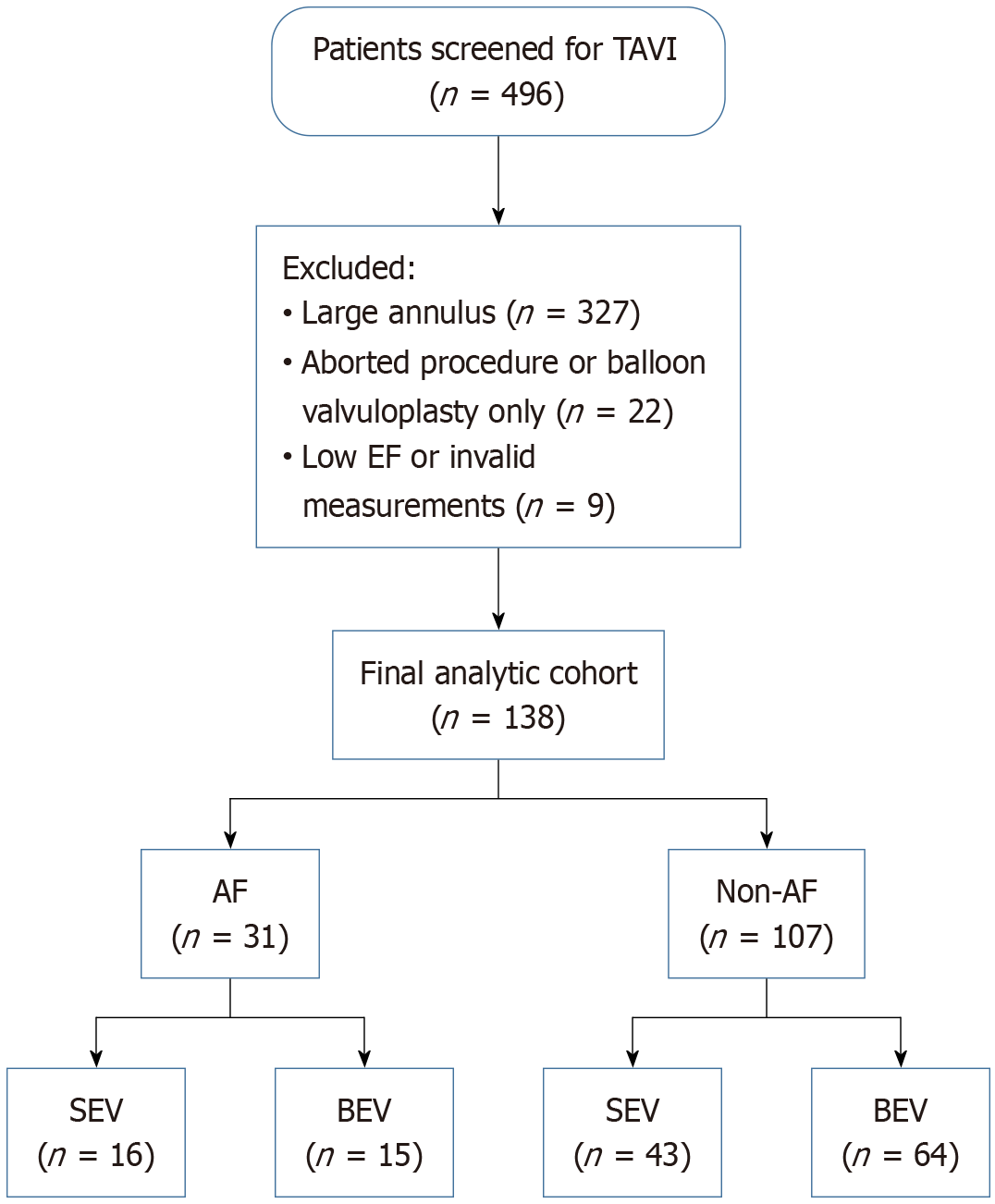
Figure 1 Study flow diagram.
Flowchart showing the total number of patients screened (n = 496), exclusions (large annulus, aborted procedure, balloon valvuloplasty only, low ejection fraction or invalid measurements), and the final analytic cohort (n = 138), subdivided into atrial fibrillation (n = 31) and non-atrial fibrillation (n = 107) groups, and further by valve type (self-expanding valves = 59; balloon-expandable valve = 79). TAVI: Transcatheter aortic valve implantation; EF: Ejection fraction; AF: Atrial fibrillation; SEV: Self-expanding valves; BEV: Balloon-expandable valve.
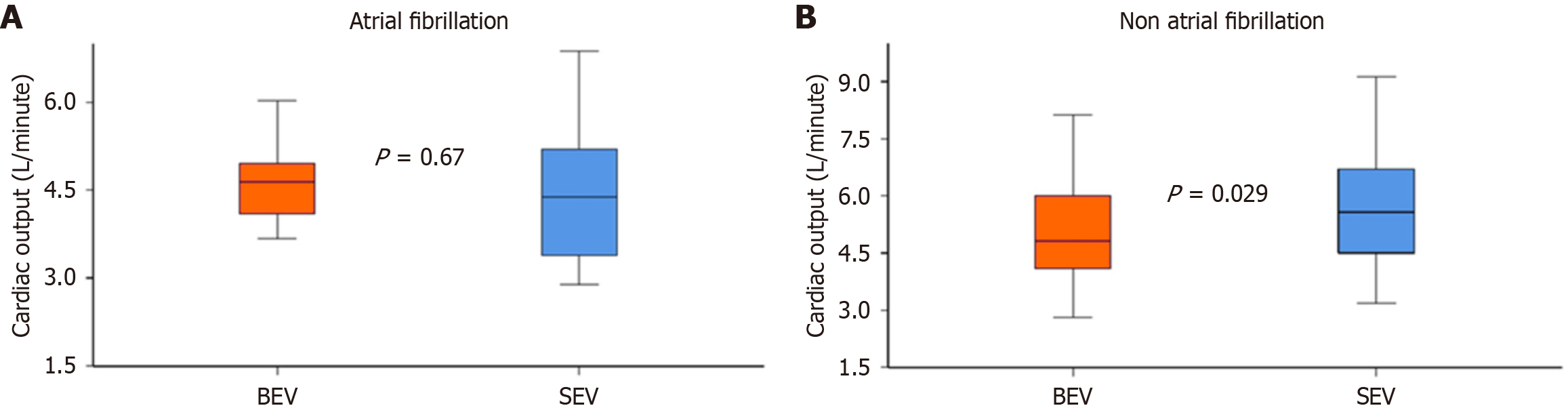
Figure 2 Post-procedural cardiac output by valve type and atrial fibrillation status.
A: Box plot comparing post-procedural cardiac output (L/minute) in patients with atrial fibrillation receiving either a balloon-expandable valve or a self-expanding valve; B: Box plot comparing post-procedural cardiac output (L/minute) in patients without atrial fibrillation receiving either a balloon-expandable valve or a self-expanding valve. BEV: Balloon-expandable valve; SEV: Self-expanding valve.
- Citation: Omari M, Ibrahim M, Abukhalaf O, Abdalwahab A, Edwards R, Das R, Zaman A, Farag M, Alkhalil M. Differences in cardiac output of patients undergoing trans-catheter aortic valve implantation according to their underlying rhythm. World J Cardiol 2026; 18(2): 110803
- URL: https://www.wjgnet.com/1949-8462/full/v18/i2/110803.htm
- DOI: https://dx.doi.org/10.4330/wjc.v18.i2.110803