
















Copyright: ©Author(s) 2026.
World J Hepatol. Mar 27, 2026; 18(3): 114768
Published online Mar 27, 2026. doi: 10.4254/wjh.v18.i3.114768
Published online Mar 27, 2026. doi: 10.4254/wjh.v18.i3.114768
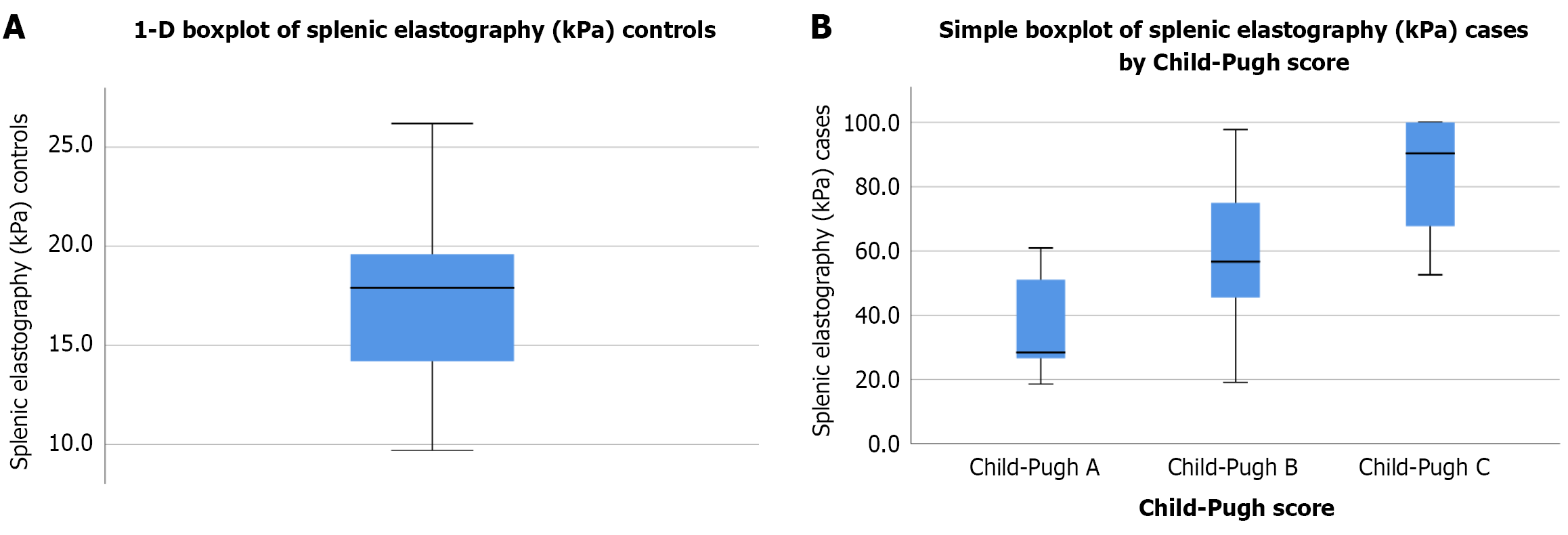
Figure 1 Boxplot.
A: Splenic stiffness in healthy controls. Y-axis: Splenic stiffness (kPa) among control group. X-axis: Control. Legend: Boxplot showing the median and interquartile range of splenic stiffness among healthy controls; B: Splenic elastography cases by Child-Pugh score. Y-axis: Splenic stiffness (kPa) among cirrhotic patients. X-axis: Child–Pugh A|B|C. Legend: Median stiffness increases with advancing class (P < 0.001, Kruskal-Wallis test).
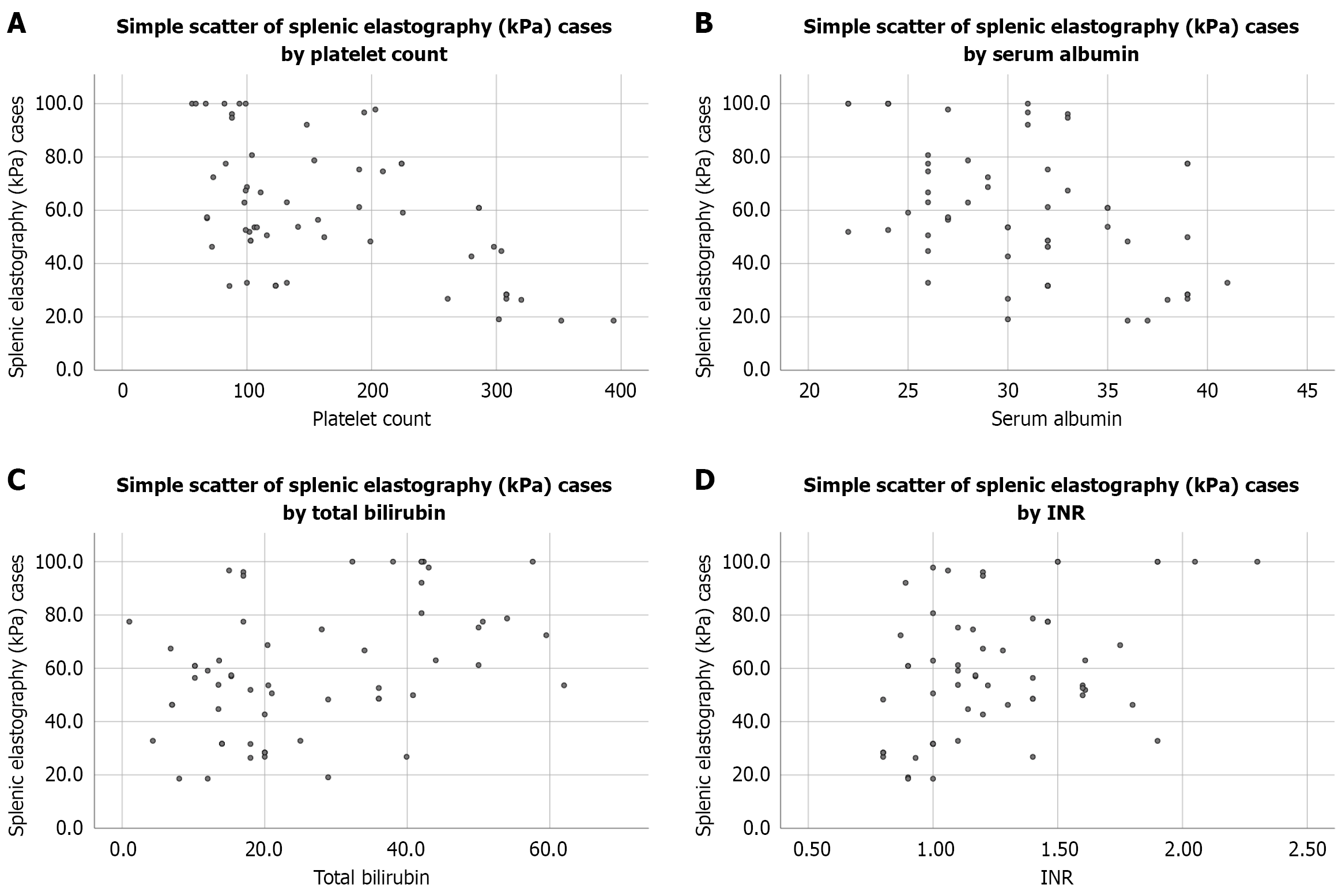
Figure 2 Scatter plots showing correlations in cirrhotic patients.
A: Correlations between splenic stiffness measurement (SSM) and platelet count. X-axis: Platelet count (× 109/L). Y-axis: Splenic stiffness (kPa). Legend: Spearman r = -0.53, P < 0.001; B: Correlations between SSM and serum albumin. X-axis: Serum albumin (g/L). Y-axis: Splenic stiffness (kPa). Legend: Spearman r = -0.47, P < 0.001; C: Correlations between SSM and total bilirubin. X-axis: Total bilirubin (μmol/L). Y-axis: Splenic stiffness (kPa). Legend: Spearman r = 0.38, P = 0.002; D: Correlations between SSM and international normalized ratio. X-axis: International normalized ratio. Y-axis: Splenic stiffness (kPa). Legend: Spearman r = 0.44, P < 0.001. INR: International normalized ratio; SSM: Splenic stiffness measurement.
- Citation: Saleh HT, Musa Y, Aminu AS, Abdullahi HZ, Samaila AA, Borodo MM. Splenic elastography in cirrhosis: A practical, non-invasive portal hypertension assessment from a Nigerian tertiary center. World J Hepatol 2026; 18(3): 114768
- URL: https://www.wjgnet.com/1948-5182/full/v18/i3/114768.htm
- DOI: https://dx.doi.org/10.4254/wjh.v18.i3.114768