
















修回日期: 2026-04-10
接受日期: 2026-04-24
在线出版日期: 2026-04-28
炎症性肠病患者在达到临床、内镜甚至组织学缓解后, 常持续存在腹痛、腹胀及排便习惯改变等肠易激综合征样症状, 严重影响患者生活质量并增加医疗负担. 该现象患病率较高, 其发病机制涉及遗传易感性、炎症后遗症、肠道微生态失调、内脏高敏感性及脑-肠互动障碍等多个层面. 临床诊断需首先排除活动性炎症及其他器质性病变. 治疗上应采取多模式综合管理, 结合生活方式调整、对症药物、神经调节剂及心理干预, 旨在改善症状并提升生活质量.
核心提要: 炎症性肠病缓解期患者肠易激综合征样症状患病率高, 其机制复杂、多维交互; 临床诊断需首先排除活动性炎症及其他器质性病变. 治疗上应采取多模式综合管理, 结合生活方式调整、对症药物、神经调节剂及心理干预, 旨在改善症状并提升生活质量.
引文著录: 周仕明, 董海滨, 张坤, 姜泊. 炎症性肠病肠易激样症状研究进展. 世界华人消化杂志 2026; 34(4): 325-330
Revised: April 10, 2026
Accepted: April 24, 2026
Published online: April 28, 2026
Patients with inflammatory bowel disease frequently experience persistent irritable bowel syndrome like symptoms, such as abdominal pain, bloating, and altered bowel habits, even after achieving clinical, endoscopic, or even histological remission. These symptoms significantly compromise patients' quality of life and increase the healthcare burden. This condition is highly prevalent, and its pathogenesis encompasses multiple dimensions, including genetic susceptibility, inflammatory sequelae, gut dysbiosis, visceral hypersensitivity, and disordered brain-gut interactions. Clinically, the diagnosis requires the initial exclusion of active inflammation and other organic pathologies. In terms of treatment, a comprehensive multimodal management strategy should be adopted, integrating lifestyle modifications, symptomatic pharmacotherapy, neuromodulators, and psychological interventions, with the aim of alleviating symptoms and improving quality of life.
- Citation: Zhou SM, Dong HB, Zhang K, Jiang B. Irritable bowel syndrome like symptoms in inflammatory bowel disease: Research progress. Shijie Huaren Xiaohua Zazhi 2026; 34(4): 325-330
- URL: https://www.wjgnet.com/1009-3079/full/v34/i4/325.htm
- DOI: https://dx.doi.org/10.11569/wcjd.v34.i4.325
核心提要: 炎症性肠病缓解期患者肠易激综合征样症状患病率高, 其机制复杂、多维交互; 临床诊断需首先排除活动性炎症及其他器质性病变. 治疗上应采取多模式综合管理, 结合生活方式调整、对症药物、神经调节剂及心理干预, 旨在改善症状并提升生活质量.
炎症性肠病(inflammatory bowel disease, IBD), 主要包括克罗恩病(Crohn's disease, CD)和溃疡性结肠炎(ulcerative colitis, UC), 是一类慢性复发性炎症性疾病, 其治疗目标已从单纯控制症状逐步升级为达到内镜甚至组织学缓解[1,2]. 临床实践发现, 即使通过生物制剂或小分子药物实现了黏膜愈合, 部分患者仍持续存在腹痛、腹胀及排便习惯改变等胃肠道症状, 此类表现类似肠易激综合征(irritable bowel syndrome, IBS)[3].
IBS属于脑-肠互动障碍, 其诊断主要基于Rome Ⅳ等症状标准, 并需排除器质性疾病[3,4]. 尽管传统观念认为IBD与IBS的诊断互斥, 但研究证实IBD缓解期患者的症状谱与IBS高度重叠, 这一现象被称为"IBD合并IBS"或"IBS样症状"[5]. 流行病学数据显示, 该现象发生率显著高于普通人群, 严重影响患者生活质量, 并增加心理负担与医疗资源消耗[6]. 本文旨在系统综述IBD患者IBS样症状的流行病学、病理生理机制及临床管理策略, 以期为临床诊疗提供参考.
流行病学研究证实了IBD患者IBS样症状的高发性及其临床重要性. Isgar等[7]报道内镜缓解期UC患者中IBS样症状患病率高达33%. Fairbrass等[8]对3169例缓解期IBD患者的分析显示, 临床、内镜及组织学缓解患者的IBS样症状患病率分别为32.5%、23.5%和25.8%, 且CD患者(36.6%)高于UC患者(28.7%). IBSEN研究[9]发现, 处于组织学缓解的UC患者IBS样症状患病率与活动期患者相当, 提示炎症并非症状的唯一驱动因素. 研究表明IBS样症状与IBD疾病活动度升高、激素使用需求增加等传统炎症指标无显著关联[10,11], 而与性别及焦虑、抑郁等心理共病密切相关[8,10]. 此类症状的持续存在不仅显著降低患者生活质量, 更导致门诊就诊与内镜检查频次增加, 造成沉重的医疗负担[8,10,12]. 除了横断面数据, IBS样症状在IBD病程中的纵向演变同样值得关注. Fairbrass等[10]的6年纵向随访研究显示, IBS样症状具有持续性, 且其存在与疾病活动度的波动无显著关联. 在疾病复发期, 功能性症状常与炎症活动交织, 进一步增加临床鉴别难度. 因此, 临床上需认识到IBS样症状在IBD全病程中均可能持续存在的动态特征(表1).
IBD患者IBS样症状的病理生理机制错综复杂, 其本质并非单纯的炎症残留或偶然共病, 而是涉及炎症后遗症、遗传易感性及脑-肠互动障碍等多维度因素的交互作用[13].
IBD与IBS存在共享的遗传易感性基础. 尽管IBS的遗传学研究起步较晚, 但已证实两者存在重叠的风险基因, 如TNFSF15基因多态性被证明同时增加CD与IBS的患病风险[14-16]. 一项西班牙研究[17]显示, IBD患者一级亲属的IBS患病率显著高于配偶对照组, 进一步佐证了遗传因素在症状重叠中的作用. 此外, 环境触发因素亦具有共性, 超加工食品的摄入已被证实可同时增加IBD和IBS的发病风险[18,19].
"感染后IBS(Post-infection IBS, PI-IBS)"模型为理解IBD缓解期症状提供了重要视角. 胃肠道感染引发的低度炎症、屏障受损及菌群紊乱可在病原体清除后持续存在[13,20], 这与IBD急性发作后的肠道改变高度相似. 研究证实, 即便内镜下黏膜愈合, IBD患者仍可能存在微观层面的异常, 如嗜铬细胞增生、5-HT代谢改变、TRPV1阳性神经纤维增多及肥大细胞活化等[21-29]. 这些外周敏化改变是导致内脏高敏感性与肠道运动异常的重要基础. 肠道微生物群失调是另一关键环节[30,31]. IBD缓解期患者常表现出与IBS类似的菌群多样性降低或特定菌群比例失调[32-35]. 部分菌群代谢产物活性异常与症状严重度究[36]及肠道通透性增加密切相关[37].
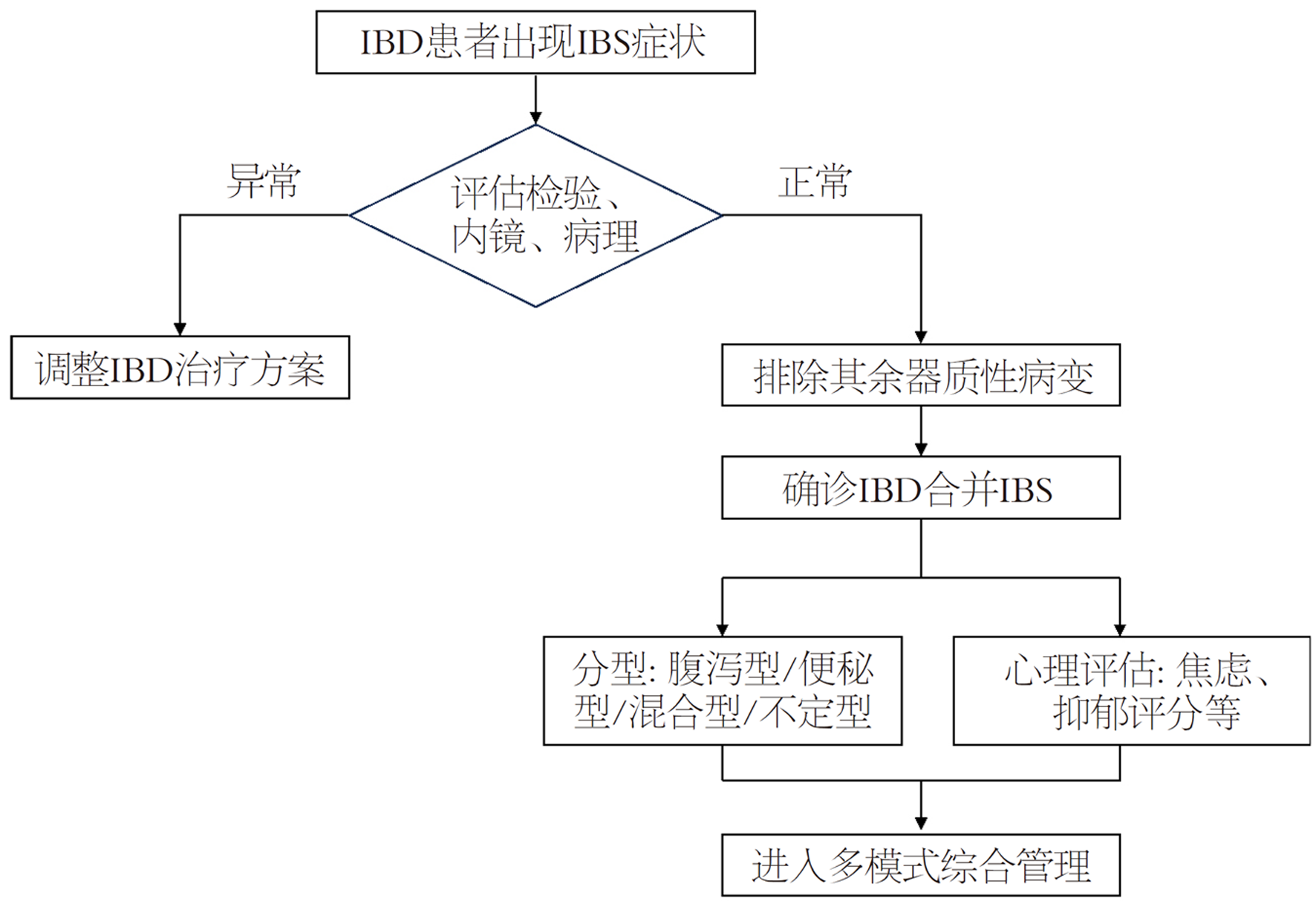
对IBD患者新发或持续胃肠道症状的首要任务是鉴别活动性炎症与IBS样症状. 诊断过程需遵循结构化步骤:
首先应通过客观指标确证炎症缓解, 评估内容涵盖临床缓解状态、生物标志物(C 型反应性蛋白、粪便钙卫蛋白)检测及内镜与组织学检查[9,48]. 鉴于部分患者内镜下黏膜外观正常而显微镜下仍存在炎症浸润, 组织学评估尤为重要. 临床实践中需结合实际情况综合判断, 避免过度活检增加患者负担. 若症状与炎症指标不符, 建议行肠道超声等影像学检查以评估透壁性愈合情况.
在确认炎症缓解后, 应依据主要症状特征(如疼痛/腹胀主导型或排便习惯改变主导型)进行分类, 以指导治疗决策. 同时, 需尽早筛查焦虑、抑郁等心理共病, 因其不仅影响症状体验, 亦是预测治疗反应的关键因素[44,49].
尚需排除其他器质性或功能性病因. 例如, CD患者回盲部切除术后需警惕胆汁酸腹泻[50]; 多发狭窄或术后患者应排除小肠细菌过度生长; 此外需鉴别乳糖不耐受、乳糜泻及甲状腺功能异常等[48]; 以便秘为主者则应考虑排便协同失调或梗阻可能[5].
经上述排查, 若症状符合IBS特征且无其他合理解释, 可确立IBD患者IBS样症状的诊断. 诊断过程中应积极向患者阐释症状性质, 避免因反复检查延误"功能性"诊断的提出, 以利于建立医患信任并及时启动治疗(图1).
目前尚无针对IBD合并IBS样症状的特异性疗法, 临床策略主要借鉴IBS管理经验, 结合IBD患者的病理生理特征, 采取多模式、个体化的综合治疗方案. 鉴于此类症状严重影响患者生活质量且常规抗炎治疗无效, 在IBD的全程管理中, 亟需将非炎症性症状的控制纳入整体治疗目标.
生活方式干预是治疗的基石, 建议患者保持规律运动、充足睡眠并进行压力管理. 饮食调整同样关键, 虽然长期盲目限制饮食易导致营养不良, 但针对性干预疗效确切. 其中, 低FODMAP饮食证据最为充分, 可有效缓解部分IBD患者的IBS样症状[51,52]. 长期实施低FODMAP饮食可能存在不良反应, 实施时建议在营养师指导下, 通过严格的限制与重新引入阶段, 识别个体化触发食物. 此外, 地中海饮食模式可作为整体健康饮食框架推荐[53].
针对腹泻型症状, 可选用洛哌丁胺等止泻药; 5-HT3受体拮抗剂(如昂丹司琼)在IBS-D中证实有效, 可延缓肠道传输并减轻腹泻[54]. 针对便秘型症状, 推荐使用渗透性泻剂或促分泌剂(如利那洛肽)[55]. 解痉药(如薄荷油、莨菪碱类)可用于缓解腹痛及肠道痉挛[56].
神经调节剂是改善腹痛及疼痛性排便障碍的重要药物. 小剂量三环类抗抑郁药(如阿米替林)兼具抗胆碱能止泻作用与中枢镇痛效应[57]; 选择性5-HT再摄取抑制剂(如艾司西酞普兰)及5-HT去甲肾上腺素再摄取抑制剂(如度洛西汀)适用于合并焦虑抑郁者, 且具有独立镇痛效果[58]. 使用时应从小剂量起始, 逐渐滴定. 但需注意, 三环类抗抑郁药及选择性5-HT再摄取抑制剂存在药物不良反应, 用药期间需密切监测患者反应及药物耐受性. 心理干预, 如认知行为疗法、正念减压疗法和肠道导向催眠疗法在IBS中疗效确切, 可调节脑-肠互动, 改善患者的认知应对策略与生活质量, 同样适用于IBD患者[59].
IBD治疗目标已由单纯控制炎症转向恢复生活质量[64]. IBS样症状是IBD缓解期的重要临床挑战, 其机制涉及遗传、微环境及脑-肠互动的多维交互. 在确认黏膜愈合后, 临床管理应积极采用以症状为导向、包含生活方式调整、对症药物、神经调节剂、心理干预及饮食疗法在内的多模式综合策略. 未来研究应聚焦于深化机制理解、发展精准诊断工具及验证个体化治疗方案, 最终实现对IBD患者全方位、全周期的健康照护, 真正达成恢复生活质量的治疗终极目标.
| 1. | Torres J, Mehandru S, Colombel JF, Peyrin-Biroulet L. Crohn's disease. Lancet. 2017;389:1741-1755. [PubMed] [DOI] |
| 2. | Ungaro R, Mehandru S, Allen PB, Peyrin-Biroulet L, Colombel JF. Ulcerative colitis. Lancet. 2017;389:1756-1770. [PubMed] [DOI] |
| 3. | Holtmann GJ, Ford AC, Talley NJ. Pathophysiology of irritable bowel syndrome. Lancet Gastroenterol Hepatol. 2016;1:133-146. [PubMed] [DOI] |
| 4. | Hellström PM, Benno P. The Rome IV: Irritable bowel syndrome - A functional disorder. Best Pract Res Clin Gastroenterol. 2019;40-41:101634. [PubMed] [DOI] |
| 5. | Wellens J, Sabino J, Vanuytsel T, Tack J, Vermeire S. Recent advances in clinical practice: mastering the challenge-managing IBS symptoms in IBD. Gut. 2025;74:312-321. [PubMed] [DOI] |
| 6. | Halpin SJ, Ford AC. Prevalence of symptoms meeting criteria for irritable bowel syndrome in inflammatory bowel disease: systematic review and meta-analysis. Am J Gastroenterol. 2012;107:1474-1482. [PubMed] [DOI] |
| 7. | Isgar B, Harman M, Kaye MD, Whorwell PJ. Symptoms of irritable bowel syndrome in ulcerative colitis in remission. Gut. 1983;24:190-192. [PubMed] [DOI] |
| 8. | Fairbrass KM, Costantino SJ, Gracie DJ, Ford AC. Prevalence of irritable bowel syndrome-type symptoms in patients with inflammatory bowel disease in remission: a systematic review and meta-analysis. Lancet Gastroenterol Hepatol. 2020;5:1053-1062. [PubMed] [DOI] |
| 9. | Henriksen M, Høivik ML, Jelsness-Jørgensen LP, Moum B; IBSEN Study Group. Irritable Bowel-like Symptoms in Ulcerative Colitis are as Common in Patients in Deep Remission as in Inflammation: Results From a Population-based Study [the IBSEN Study]. J Crohns Colitis. 2018;12:389-393. [PubMed] [DOI] |
| 10. | Fairbrass KM, Hamlin PJ, Gracie DJ, Ford AC. Natural history and impact of irritable bowel syndrome-type symptoms in inflammatory bowel disease during 6 years of longitudinal follow-up. Aliment Pharmacol Ther. 2022;56:1264-1273. [PubMed] [DOI] |
| 11. | Berrill JW, Green JT, Hood K, Campbell AK. Symptoms of irritable bowel syndrome in patients with inflammatory bowel disease: examining the role of sub-clinical inflammation and the impact on clinical assessment of disease activity. Aliment Pharmacol Ther. 2013;38:44-51. [PubMed] [DOI] |
| 12. | Gracie DJ, Hamlin JP, Ford AC. Longitudinal impact of IBS-type symptoms on disease activity, healthcare utilization, psychological health, and quality of life in inflammatory bowel disease. Am J Gastroenterol. 2018;113:702-712. [PubMed] [DOI] |
| 13. | Spiller R, Major G. IBS and IBD - separate entities or on a spectrum? Nat Rev Gastroenterol Hepatol. 2016;13:613-621. [PubMed] [DOI] |
| 14. | Czogalla B, Schmitteckert S, Houghton LA, Sayuk GS, Camilleri M, Olivo-Diaz A, Spiller R, Wouters MM, Boeckxstaens G, Bermejo JL, Niesler B. A meta-analysis of immunogenetic Case-Control Association Studies in irritable bowel syndrome. Neurogastroenterol Motil. 2015;27:717-727. [PubMed] [DOI] |
| 15. | Zucchelli M, Camilleri M, Andreasson AN, Bresso F, Dlugosz A, Halfvarson J, Törkvist L, Schmidt PT, Karling P, Ohlsson B, Duerr RH, Simren M, Lindberg G, Agreus L, Carlson P, Zinsmeister AR, D'Amato M. Association of TNFSF15 polymorphism with irritable bowel syndrome. Gut. 2011;60:1671-1677. [PubMed] [DOI] |
| 16. | Swan C, Duroudier NP, Campbell E, Zaitoun A, Hastings M, Dukes GE, Cox J, Kelly FM, Wilde J, Lennon MG, Neal KR, Whorwell PJ, Hall IP, Spiller RC. Identifying and testing candidate genetic polymorphisms in the irritable bowel syndrome (IBS): association with TNFSF15 and TNFα. Gut. 2013;62:985-994. [PubMed] [DOI] |
| 17. | Aguas M, Garrigues V, Bastida G, Nos P, Ortiz V, Fernandez A, Ponce J. Prevalence of irritable bowel syndrome (IBS) in first-degree relatives of patients with inflammatory bowel disease (IBD). J Crohns Colitis. 2011;5:227-233. [PubMed] [DOI] |
| 18. | Wu S, Yang Z, Liu S, Zhang Q, Zhang S, Zhu S. Ultra-Processed Food Consumption and Long-Term Risk of Irritable Bowel Syndrome: A Large-Scale Prospective Cohort Study. Clin Gastroenterol Hepatol. 2024;22:1497-1507.e5. [PubMed] [DOI] |
| 19. | Chen J, Wellens J, Kalla R, Fu T, Deng M, Zhang H, Yuan S, Wang X, Theodoratou E, Li X, Satsangi J. Intake of Ultra-processed Foods Is Associated with an Increased Risk of Crohn's Disease: A Cross-sectional and Prospective Analysis of 187 154 Participants in the UK Biobank. J Crohns Colitis. 2023;17:535-552. [PubMed] [DOI] |
| 20. | Spiller RC, Jenkins D, Thornley JP, Hebden JM, Wright T, Skinner M, Neal KR. Increased rectal mucosal enteroendocrine cells, T lymphocytes, and increased gut permeability following acute Campylobacter enteritis and in post-dysenteric irritable bowel syndrome. Gut. 2000;47:804-811. [PubMed] [DOI] |
| 21. | Barreau F, Salvador-Cartier C, Houdeau E, Bueno L, Fioramonti J. Long-term alterations of colonic nerve-mast cell interactions induced by neonatal maternal deprivation in rats. Gut. 2008;57:582-590. [PubMed] [DOI] |
| 22. | Vicario M, Alonso C, Guilarte M, Serra J, Martínez C, González-Castro AM, Lobo B, Antolín M, Andreu AL, García-Arumí E, Casellas M, Saperas E, Malagelada JR, Azpiroz F, Santos J. Chronic psychosocial stress induces reversible mitochondrial damage and corticotropin-releasing factor receptor type-1 upregulation in the rat intestine and IBS-like gut dysfunction. Psychoneuroendocrinology. 2012;37:65-77. [PubMed] [DOI] |
| 23. | Farhadi A, Keshavarzian A, Van de Kar LD, Jakate S, Domm A, Zhang L, Shaikh M, Banan A, Fields JZ. Heightened responses to stressors in patients with inflammatory bowel disease. Am J Gastroenterol. 2005;100:1796-1804. [PubMed] [DOI] |
| 24. | Dunlop SP, Jenkins D, Neal KR, Spiller RC. Relative importance of enterochromaffin cell hyperplasia, anxiety, and depression in postinfectious IBS. Gastroenterology. 2003;125:1651-1659. [PubMed] [DOI] |
| 25. | Cremon C, Carini G, Wang B, Vasina V, Cogliandro RF, De Giorgio R, Stanghellini V, Grundy D, Tonini M, De Ponti F, Corinaldesi R, Barbara G. Intestinal serotonin release, sensory neuron activation, and abdominal pain in irritable bowel syndrome. Am J Gastroenterol. 2011;106:1290-1298. [PubMed] [DOI] |
| 26. | Foley S, Garsed K, Singh G, Duroudier NP, Swan C, Hall IP, Zaitoun A, Bennett A, Marsden C, Holmes G, Walls A, Spiller RC. Impaired uptake of serotonin by platelets from patients with irritable bowel syndrome correlates with duodenal immune activation. Gastroenterology. 2011;140:1434-43.e1. [PubMed] [DOI] |
| 27. | Dunlop SP, Coleman NS, Blackshaw E, Perkins AC, Singh G, Marsden CA, Spiller RC. Abnormalities of 5-hydroxytryptamine metabolism in irritable bowel syndrome. Clin Gastroenterol Hepatol. 2005;3:349-357. [PubMed] [DOI] |
| 28. | Atkinson W, Lockhart S, Whorwell PJ, Keevil B, Houghton LA. Altered 5-hydroxytryptamine signaling in patients with constipation- and diarrhea-predominant irritable bowel syndrome. Gastroenterology. 2006;130:34-43. [PubMed] [DOI] |
| 29. | Matricon J, Meleine M, Gelot A, Piche T, Dapoigny M, Muller E, Ardid D. Review article: Associations between immune activation, intestinal permeability and the irritable bowel syndrome. Aliment Pharmacol Ther. 2012;36:1009-1031. [PubMed] [DOI] |
| 30. | Rajilić-Stojanović M, Jonkers DM, Salonen A, Hanevik K, Raes J, Jalanka J, de Vos WM, Manichanh C, Golic N, Enck P, Philippou E, Iraqi FA, Clarke G, Spiller RC, Penders J. Intestinal microbiota and diet in IBS: causes, consequences, or epiphenomena? Am J Gastroenterol. 2015;110:278-287. [PubMed] [DOI] |
| 31. | Vandeputte D, Falony G, Vieira-Silva S, Tito RY, Joossens M, Raes J. Stool consistency is strongly associated with gut microbiota richness and composition, enterotypes and bacterial growth rates. Gut. 2016;65:57-62. [PubMed] [DOI] |
| 32. | Boland K, Bedrani L, Turpin W, Kabakchiev B, Stempak J, Borowski K, Nguyen G, Steinhart AH, Smith MI, Croitoru K, Silverberg MS. Persistent Diarrhea in Patients With Crohn's Disease After Mucosal Healing Is Associated With Lower Diversity of the Intestinal Microbiome and Increased Dysbiosis. Clin Gastroenterol Hepatol. 2021;19:296-304.e3. [PubMed] [DOI] |
| 33. | Wright EK, Kamm MA, Teo SM, Inouye M, Wagner J, Kirkwood CD. Recent advances in characterizing the gastrointestinal microbiome in Crohn's disease: a systematic review. Inflamm Bowel Dis. 2015;21:1219-1228. [PubMed] [DOI] |
| 34. | Jalanka-Tuovinen J, Salojärvi J, Salonen A, Immonen O, Garsed K, Kelly FM, Zaitoun A, Palva A, Spiller RC, de Vos WM. Faecal microbiota composition and host-microbe cross-talk following gastroenteritis and in postinfectious irritable bowel syndrome. Gut. 2014;63:1737-1745. [PubMed] [DOI] |
| 35. | Jeffery IB, O'Toole PW, Öhman L, Claesson MJ, Deane J, Quigley EM, Simrén M. An irritable bowel syndrome subtype defined by species-specific alterations in faecal microbiota. Gut. 2012;61:997-1006. [PubMed] [DOI] |
| 36. | Edwinson AL, Yang L, Peters S, Hanning N, Jeraldo P, Jagtap P, Simpson JB, Yang TY, Kumar P, Mehta S, Nair A, Breen-Lyles M, Chikkamenahalli L, Graham RP, De Winter B, Patel R, Dasari S, Kashyap P, Griffin T, Chen J, Farrugia G, Redinbo MR, Grover M. Gut microbial β-glucuronidases regulate host luminal proteases and are depleted in irritable bowel syndrome. Nat Microbiol. 2022;7:680-694. [PubMed] [DOI] |
| 37. | Vivinus-Nébot M, Frin-Mathy G, Bzioueche H, Dainese R, Bernard G, Anty R, Filippi J, Saint-Paul MC, Tulic MK, Verhasselt V, Hébuterne X, Piche T. Functional bowel symptoms in quiescent inflammatory bowel diseases: role of epithelial barrier disruption and low-grade inflammation. Gut. 2014;63:744-752. [PubMed] [DOI] |
| 38. | van Hoboken EA, Thijssen AY, Verhaaren R, van der Veek PP, Prins FA, Verspaget HW, Masclee AA. Symptoms in patients with ulcerative colitis in remission are associated with visceral hypersensitivity and mast cell activity. Scand J Gastroenterol. 2011;46:981-987. [PubMed] [DOI] |
| 39. | Mavroudis G, Strid H, Jonefjäll B, Simrén M. Visceral hypersensitivity is together with psychological distress and female gender associated with severity of IBS-like symptoms in quiescent ulcerative colitis. Neurogastroenterol Motil. 2021;33:e13998. [PubMed] [DOI] |
| 40. | Akbar A, Yiangou Y, Facer P, Walters JR, Anand P, Ghosh S. Increased capsaicin receptor TRPV1-expressing sensory fibres in irritable bowel syndrome and their correlation with abdominal pain. Gut. 2008;57:923-929. [PubMed] [DOI] |
| 41. | Gracie DJ, Hamlin PJ, Ford AC. The influence of the brain-gut axis in inflammatory bowel disease and possible implications for treatment. Lancet Gastroenterol Hepatol. 2019;4:632-642. [PubMed] [DOI] |
| 42. | Schneider KM, Blank N, Alvarez Y, Thum K, Lundgren P, Litichevskiy L, Sleeman M, Bahnsen K, Kim J, Kardo S, Patel S, Dohnalová L, Uhr GT, Descamps HC, Kircher S, McSween AM, Ardabili AR, Nemec KM, Jimenez MT, Glotfelty LG, Eisenberg JD, Furth EE, Henao-Mejia J, Bennett FC, Pierik MJ, Romberg-Camps M, Mujagic Z, Prinz M, Schneider CV, Wherry EJ, Bewtra M, Heuckeroth RO, Levy M, Thaiss CA. The enteric nervous system relays psychological stress to intestinal inflammation. Cell. 2023;186:2823-2838.e20. [PubMed] [DOI] |
| 43. | Johnson JD, Campisi J, Sharkey CM, Kennedy SL, Nickerson M, Greenwood BN, Fleshner M. Catecholamines mediate stress-induced increases in peripheral and central inflammatory cytokines. Neuroscience. 2005;135:1295-1307. [PubMed] [DOI] |
| 44. | Fairbrass KM, Lovatt J, Barberio B, Yuan Y, Gracie DJ, Ford AC. Bidirectional brain-gut axis effects influence mood and prognosis in IBD: a systematic review and meta-analysis. Gut. 2022;71:1773-1780. [PubMed] [DOI] |
| 45. | Linden DR, Chen JX, Gershon MD, Sharkey KA, Mawe GM. Serotonin availability is increased in mucosa of guinea pigs with TNBS-induced colitis. Am J Physiol Gastrointest Liver Physiol. 2003;285:G207-G216. [PubMed] [DOI] |
| 46. | Wheatcroft J, Wakelin D, Smith A, Mahoney CR, Mawe G, Spiller R. Enterochromaffin cell hyperplasia and decreased serotonin transporter in a mouse model of postinfectious bowel dysfunction. Neurogastroenterol Motil. 2005;17:863-870. [PubMed] [DOI] |
| 47. | Minderhoud IM, Oldenburg B, Schipper ME, ter Linde JJ, Samsom M. Serotonin synthesis and uptake in symptomatic patients with Crohn's disease in remission. Clin Gastroenterol Hepatol. 2007;5:714-720. [PubMed] [DOI] |
| 48. | Colombel JF, Shin A, Gibson PR. AGA Clinical Practice Update on Functional Gastrointestinal Symptoms in Patients With Inflammatory Bowel Disease: Expert Review. Clin Gastroenterol Hepatol. 2019;17:380-390.e1. [PubMed] [DOI] |
| 49. | Janssen LM, Rezazadeh Ardabili A, Romberg-Camps MJL, Winkens B, van den Broek RJ, Hulst J, Verwijs HJA, Keszthelyi D, Jonkers DMAE, van Bodegraven AA, Pierik MJ, Mujagic Z. Abdominal pain in patients with inflammatory bowel disease in remission: A prospective study on contributing factors. Aliment Pharmacol Ther. 2023;58:1041-1051. [PubMed] [DOI] |
| 50. | Lenicek M, Duricova D, Komarek V, Gabrysova B, Lukas M, Smerhovsky Z, Vitek L. Bile acid malabsorption in inflammatory bowel disease: assessment by serum markers. Inflamm Bowel Dis. 2011;17:1322-1327. [PubMed] [DOI] |
| 51. | Chey WD, Hashash JG, Manning L, Chang L. AGA Clinical Practice Update on the Role of Diet in Irritable Bowel Syndrome: Expert Review. Gastroenterology. 2022;162:1737-1745.e5. [PubMed] [DOI] |
| 52. | Gibson PR, Yao CK, Halmos EP. Review article: Evidence-based dietary management of inflammatory bowel disease. Aliment Pharmacol Ther. 2024;60:1215-1233. [PubMed] [DOI] |
| 53. | Hashash JG, Elkins J, Lewis JD, Binion DG. AGA Clinical Practice Update on Diet and Nutritional Therapies in Patients With Inflammatory Bowel Disease: Expert Review. Gastroenterology. 2024;166:521-532. [PubMed] [DOI] |
| 54. | Garsed K, Chernova J, Hastings M, Lam C, Marciani L, Singh G, Henry A, Hall I, Whorwell P, Spiller R. A randomised trial of ondansetron for the treatment of irritable bowel syndrome with diarrhoea. Gut. 2014;63:1617-1625. [PubMed] [DOI] |
| 55. | Castro J, Harrington AM, Hughes PA, Martin CM, Ge P, Shea CM, Jin H, Jacobson S, Hannig G, Mann E, Cohen MB, MacDougall JE, Lavins BJ, Kurtz CB, Silos-Santiago I, Johnston JM, Currie MG, Blackshaw LA, Brierley SM. Linaclotide inhibits colonic nociceptors and relieves abdominal pain via guanylate cyclase-C and extracellular cyclic guanosine 3',5'-monophosphate. Gastroenterology. 2013;145:1334-46.e1-11. [PubMed] [DOI] |
| 56. | Decraecker L, De Looze D, Hirsch DP, De Schepper H, Arts J, Caenepeel P, Bredenoord AJ, Kolkman J, Bellens K, Van Beek K, Pia F, Peetermans W, Vanuytsel T, Denadai-Souza A, Belmans A, Boeckxstaens G. Treatment of non-constipated irritable bowel syndrome with the histamine 1 receptor antagonist ebastine: a randomised, double-blind, placebo-controlled trial. Gut. 2024;73:459-469. [PubMed] [DOI] |
| 57. | Ford AC, Vanner S, Kashyap PC, Nasser Y. Chronic Visceral Pain: New Peripheral Mechanistic Insights and Resulting Treatments. Gastroenterology. 2024;166:976-994. [PubMed] [DOI] |
| 58. | Mikocka-Walus A, Ford AC, Drossman DA. Antidepressants in inflammatory bowel disease. Nat Rev Gastroenterol Hepatol. 2020;17:184-192. [PubMed] [DOI] |
| 59. | Ballou S, Keefer L. Psychological Interventions for Irritable Bowel Syndrome and Inflammatory Bowel Diseases. Clin Transl Gastroenterol. 2017;8:e214. [PubMed] [DOI] |
| 60. | Zhang XF, Guan XX, Tang YJ, Sun JF, Wang XK, Wang WD, Fan JM. Clinical effects and gut microbiota changes of using probiotics, prebiotics or synbiotics in inflammatory bowel disease: a systematic review and meta-analysis. Eur J Nutr. 2021;60:2855-2875. [PubMed] [DOI] |
| 61. | Goodoory VC, Khasawneh M, Black CJ, Quigley EMM, Moayyedi P, Ford AC. Efficacy of Probiotics in Irritable Bowel Syndrome: Systematic Review and Meta-analysis. Gastroenterology. 2023;165:1206-1218. [PubMed] [DOI] |
| 62. | Colman RJ, Rubin DT. Fecal microbiota transplantation as therapy for inflammatory bowel disease: a systematic review and meta-analysis. J Crohns Colitis. 2014;8:1569-1581. [PubMed] [DOI] |
| 63. | Decraecker L, Boeckxstaens G, Denadai-Souza A. Inhibition of Serine Proteases as a Novel Therapeutic Strategy for Abdominal Pain in IBS. Front Physiol. 2022;13:880422. [PubMed] [DOI] |
| 64. | Turner D, Ricciuto A, Lewis A, D'Amico F, Dhaliwal J, Griffiths AM, Bettenworth D, Sandborn WJ, Sands BE, Reinisch W, Schölmerich J, Bemelman W, Danese S, Mary JY, Rubin D, Colombel JF, Peyrin-Biroulet L, Dotan I, Abreu MT, Dignass A, International Organization for the Study of IBD. STRIDE-II: An Update on the Selecting Therapeutic Targets in Inflammatory Bowel Disease (STRIDE) Initiative of the International Organization for the Study of IBD (IOIBD): Determining Therapeutic Goals for Treat-to-Target strategies in IBD. Gastroenterology. 2021;160:1570-1583. [PubMed] [DOI] |
学科分类: 胃肠病学和肝病学
手稿来源地: 北京市
同行评议报告学术质量分类
A级 (优秀): 0
B级 (非常好): 0
C级 (良好): C
D级 (一般): D
E级 (差): 0
科学编辑: 刘继红 制作编辑:张砚梁