
















Copyright: ©Author(s) 2026.
World J Gastroenterol. Jun 28, 2026; 32(24): 119127
Published online Jun 28, 2026. doi: 10.3748/wjg.119127
Published online Jun 28, 2026. doi: 10.3748/wjg.119127
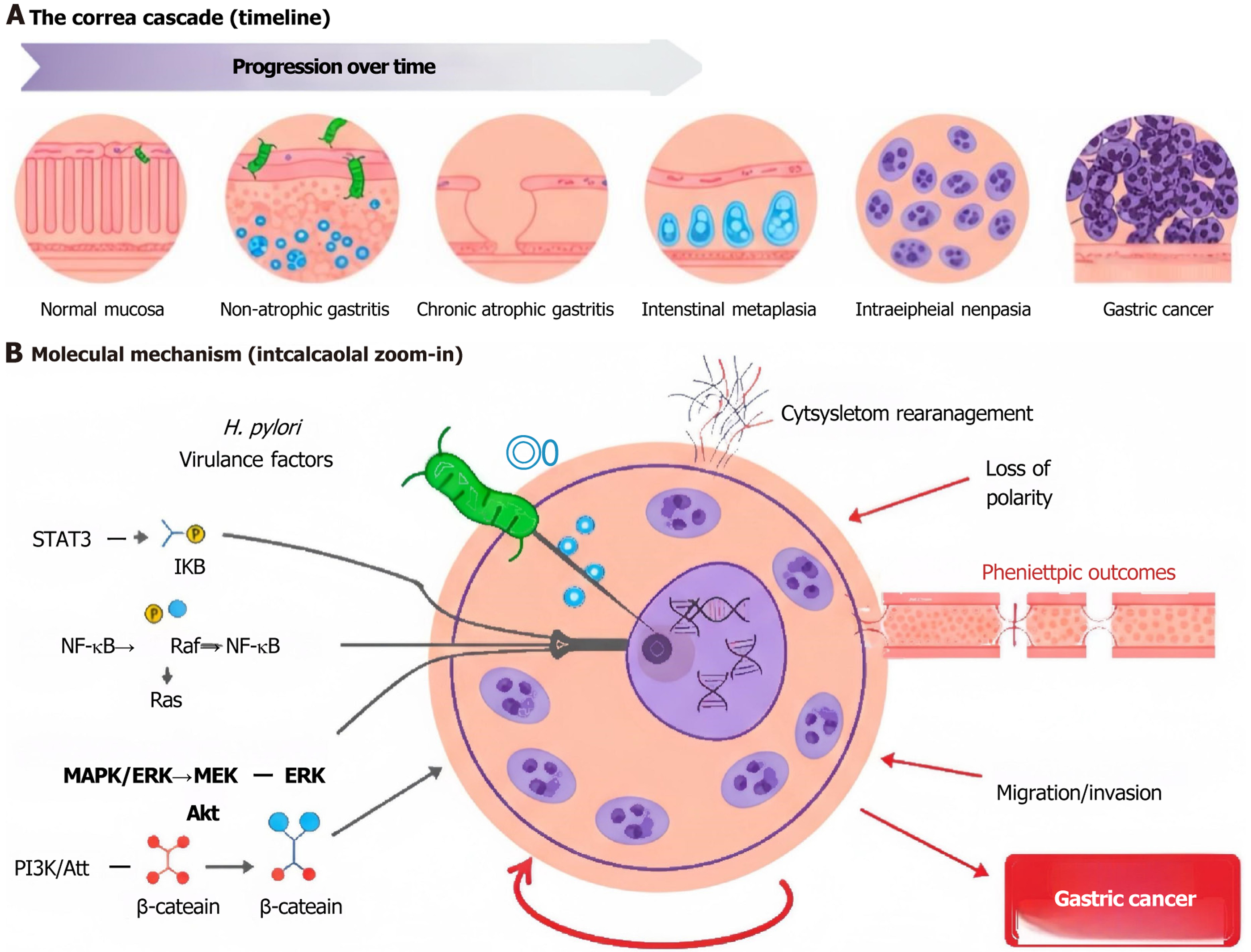
Figure 1 Mechanism of H.
pylori-induced gastric cancer. A: The Correa cascade illustrates the histopathological progression from normal gastric mucosa to gastric cancer over time; B: Molecular mechanisms of H. pylori infection, highlighting key virulence factors and signaling pathways (e.g., signal transducer and activator of transcription 3, nuclear factor-κB, mitogen-activated protein kinase/extracellular signal-regulated kinase, phosphoinositide 3-kinases/protein kinase B, β-catenin) that promote cytoskeleton rearrangement, loss of cell polarity, and enhanced migration/invasion, ultimately contributing to gastric cancer development. STAT3: Signal transducer and activator of transcription 3; NF-κB: Nuclear factor-κB; MAPK: Mitogen-activated protein kinase; ERK: Extracellular signal-regulated kinase; Akt: Protein kinase B; PI3K: Phosphoinositide 3-kinases; H. pylori: H. pylori.
- Citation: Jiang JJ, Chen K, Weng T, Hong JM, Qin WY. Early screening and risk factors for gastric cancer. World J Gastroenterol 2026; 32(24): 119127
- URL: https://www.wjgnet.com/1007-9327/full/v32/i24/119127.htm
- DOI: https://dx.doi.org/10.3748/wjg.119127