
















Copyright: ©Author(s) 2026.
World J Gastroenterol. Jun 28, 2026; 32(24): 118637
Published online Jun 28, 2026. doi: 10.3748/wjg.118637
Published online Jun 28, 2026. doi: 10.3748/wjg.118637
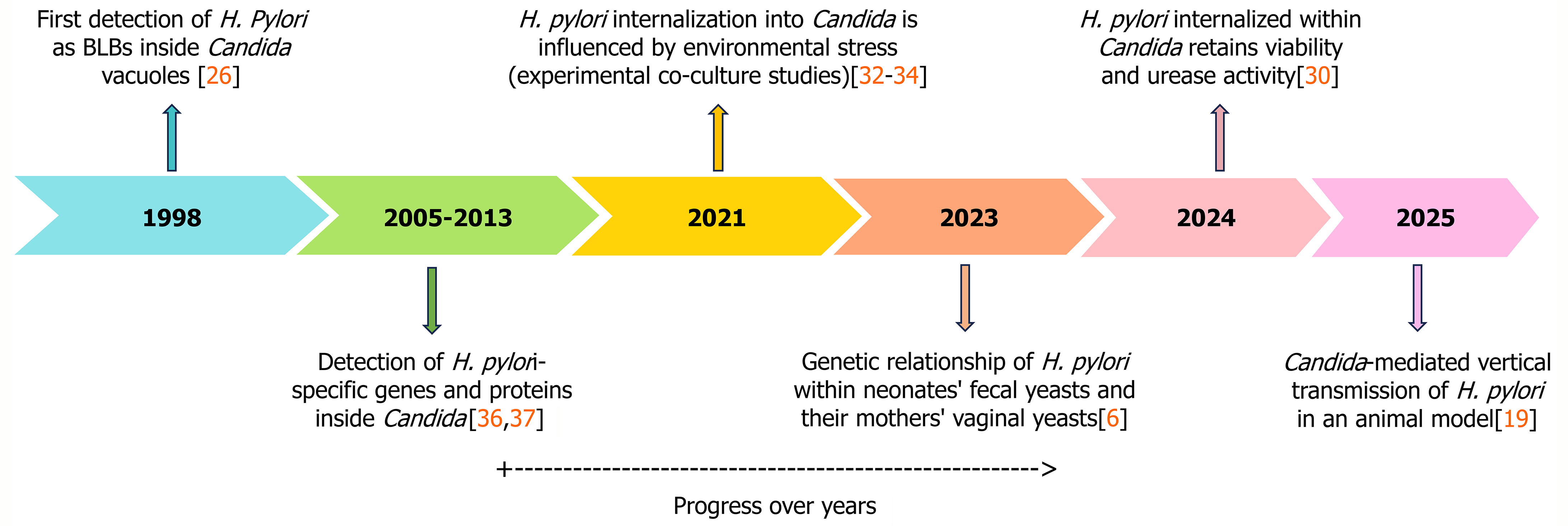
Figure 1 Chronological timeline of development in Helicobacter pylori-Candida research: From internalization to vertical transmission[6,19,26,30,32-34,36,37].
Helicobacter pylori (H. pylori) was initially detected as bacterium-like bodies within Candida vacuoles, and its specific genes and proteins were subsequently identified inside the yeast. Experimental co-culture studies demonstrated that environmental stress influences its internalization, while genetic analyses revealed a relationship between H. pylori in neonates’ fecal yeasts and their mothers’ vaginal yeasts. Once internalized, H. pylori retained viability and urease activity, ultimately enabling Candida-mediated vertical transmission in an animal model, highlighting Candida’s role as a reservoir and vehicle for maternal–neonatal transmission. H. pylori: Helicobacter pylori.
- Citation: Said ZNA, Alkhawagah SM. Beyond fecal-oral routes - Candida as a reservoir for vertical transmission of Helicobacter pylori: Insights from a murine model. World J Gastroenterol 2026; 32(24): 118637
- URL: https://www.wjgnet.com/1007-9327/full/v32/i24/118637.htm
- DOI: https://dx.doi.org/10.3748/wjg.118637