
















©The Author(s) 2026.
World J Gastroenterol. Jan 14, 2026; 32(2): 113432
Published online Jan 14, 2026. doi: 10.3748/wjg.v32.i2.113432
Published online Jan 14, 2026. doi: 10.3748/wjg.v32.i2.113432
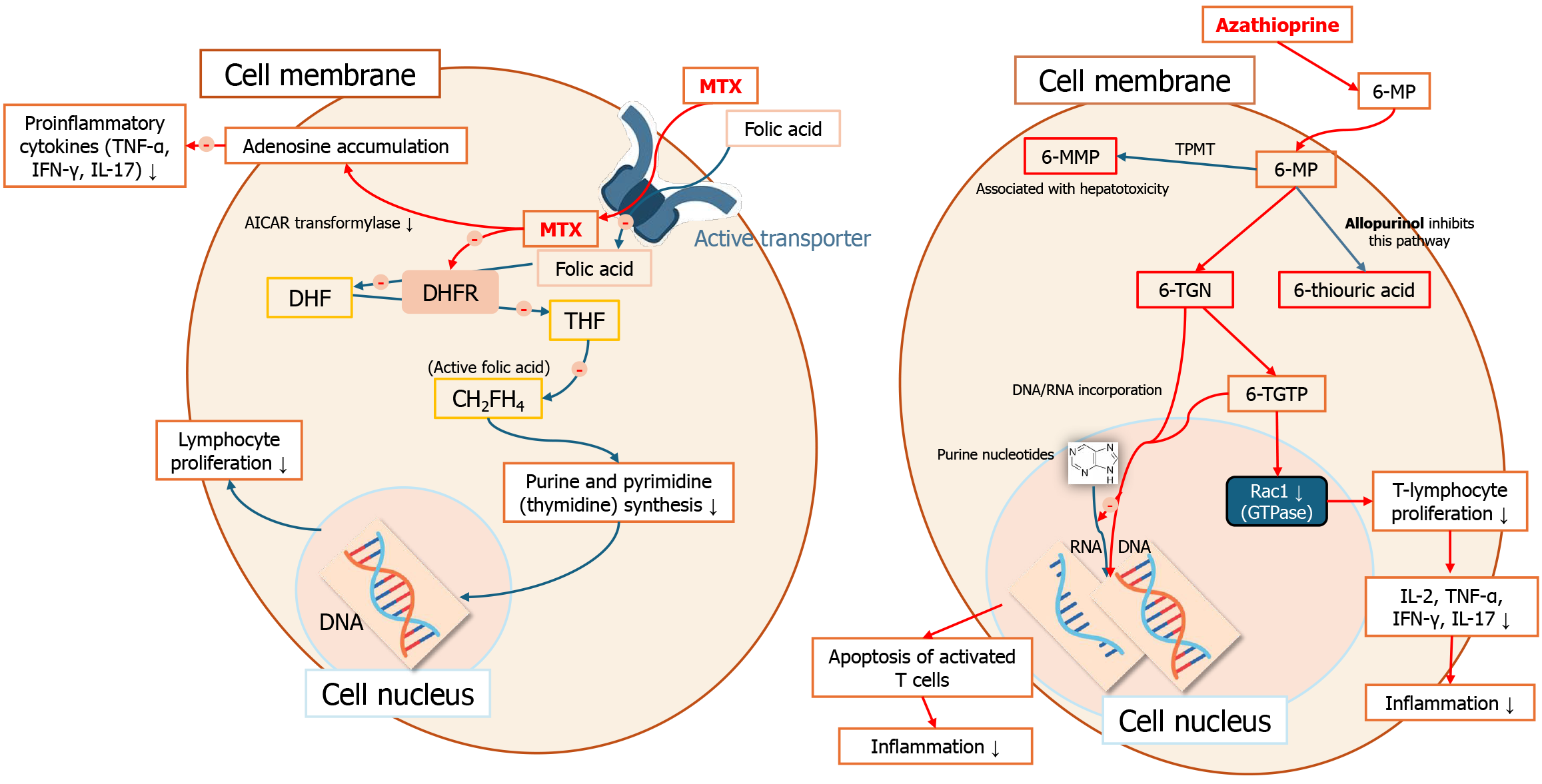
Figure 1 Methotrexate (left) inhibits dihydrofolate reductase, reducing purine and pyrimidine synthesis and promoting adenosine accumulation, which together suppress lymphocyte proliferation and proinflammatory cytokine production.
Azathioprine (right) is converted to 6-mercaptopurine, which undergoes metabolism via three major pathways: Incorporation into 6-thioguanine nucleotide that induces T-cell apoptosis and Rac1 inhibition; conversion to 6-methylmercaptopurine through thiopurine methyltransferase, which in excessive amounts is associated with hepatotoxicity; and degradation to 6-thiouric acid via xanthine oxidase, an inactive metabolite. Concomitant allopurinol therapy inhibits the xanthine oxidase-mediated pathway, thereby shunting 6-mercaptopurine metabolism toward 6-thioguanine nucleotide and increasing the risk of toxicity. MTX: Methotrexate; THF: Tetrahydrofolate; DHFR: Dihydrofolate reductase; DHF: Dihydrofolate; TNF: Tumor necrosis factor; IFN: Interferon; IL: Interleukin; 6-MP: 6-mercaptopurine; 6-MMP: 6-methylmercaptopurine; TPMT: Thiopurine methyltransferase; 6-TGN: 6-thioguanine nucleotide; 6-TGTP: 6-thioguanosine triphosphate; CH2FH4: 5,10-methylene tetrahydrofolate.
- Citation: Seo JY, Yoo JH. Beyond rheumatology: Reconsidering methotrexate for Crohn’s disease in the biologic era. World J Gastroenterol 2026; 32(2): 113432
- URL: https://www.wjgnet.com/1007-9327/full/v32/i2/113432.htm
- DOI: https://dx.doi.org/10.3748/wjg.v32.i2.113432