
















Copyright: ©Author(s) 2026.
World J Psychiatry. Jun 19, 2026; 16(6): 116745
Published online Jun 19, 2026. doi: 10.5498/wjp.v16.i6.116745
Published online Jun 19, 2026. doi: 10.5498/wjp.v16.i6.116745
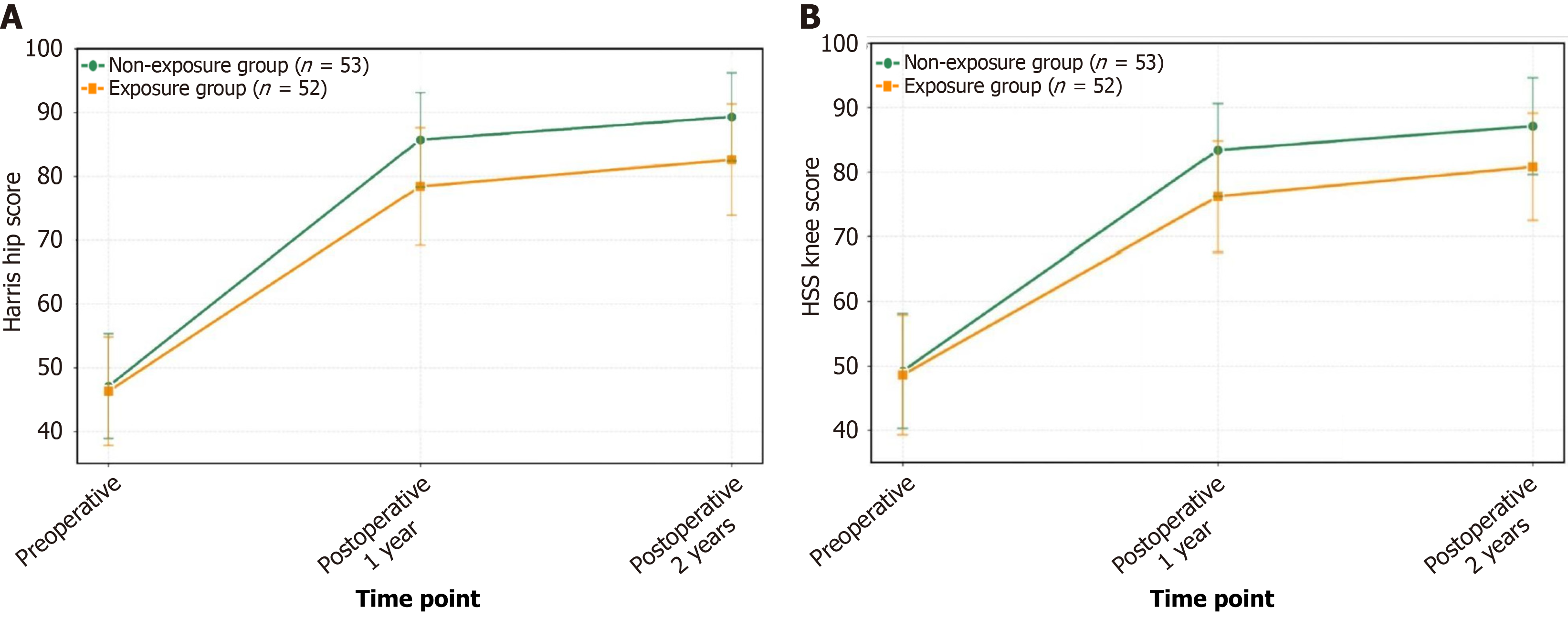
Figure 1 Postoperative functional recovery: Comparison of Harris Hip and Hospital for Special Surgery Knee Scores between exposure groups over 2 years.
A: Comparison of Harris Hip Scores between groupsin total hip arthroplasty patients. The graph shows the trends in Hardship scores for the non-exposure group (n = 53) and exposure group (n = 42) at preoperative, 1-year postoperative, and 2-year postoperative time points. Both groups had similar baseline scores (approximately 45) preoperatively, with improvement over time. At 2 years postoperatively, the non-exposure group reached approximately 90 points, while the exposure group reached approximately 83 points. Error bars indicate standard deviation; B: Comparison of Hospital for Special Surgery Knee Scores between groups in total knee arthroplasty patients. The graph shows the trends in Hospital for Special Surgery knee scores for the non-exposure group (n = 39) and exposure group (n = 40) at preoperative, 1-year postoperative, and 2-year postoperative time points. Both groups had similar baseline scores (approximately 50) preoperatively, with significant improvement over time. At 2 years postoperatively, the non-exposure group reached approximately 87 points, while the exposure group reached approximately 81 points. Error bars indicate standard deviation. HSS: Hospital for Special Surgery.
- Citation: Lian YJ, Lu JN, Ru QC, Zhu YK, Yu ZY, Guo X. Preoperative anxiety and depression predict two-year outcomes after total hip or knee arthroplasty. World J Psychiatry 2026; 16(6): 116745
- URL: https://www.wjgnet.com/2220-3206/full/v16/i6/116745.htm
- DOI: https://dx.doi.org/10.5498/wjp.v16.i6.116745