
















©The Author(s) 2026.
World J Psychiatry. Feb 19, 2026; 16(2): 113887
Published online Feb 19, 2026. doi: 10.5498/wjp.v16.i2.113887
Published online Feb 19, 2026. doi: 10.5498/wjp.v16.i2.113887
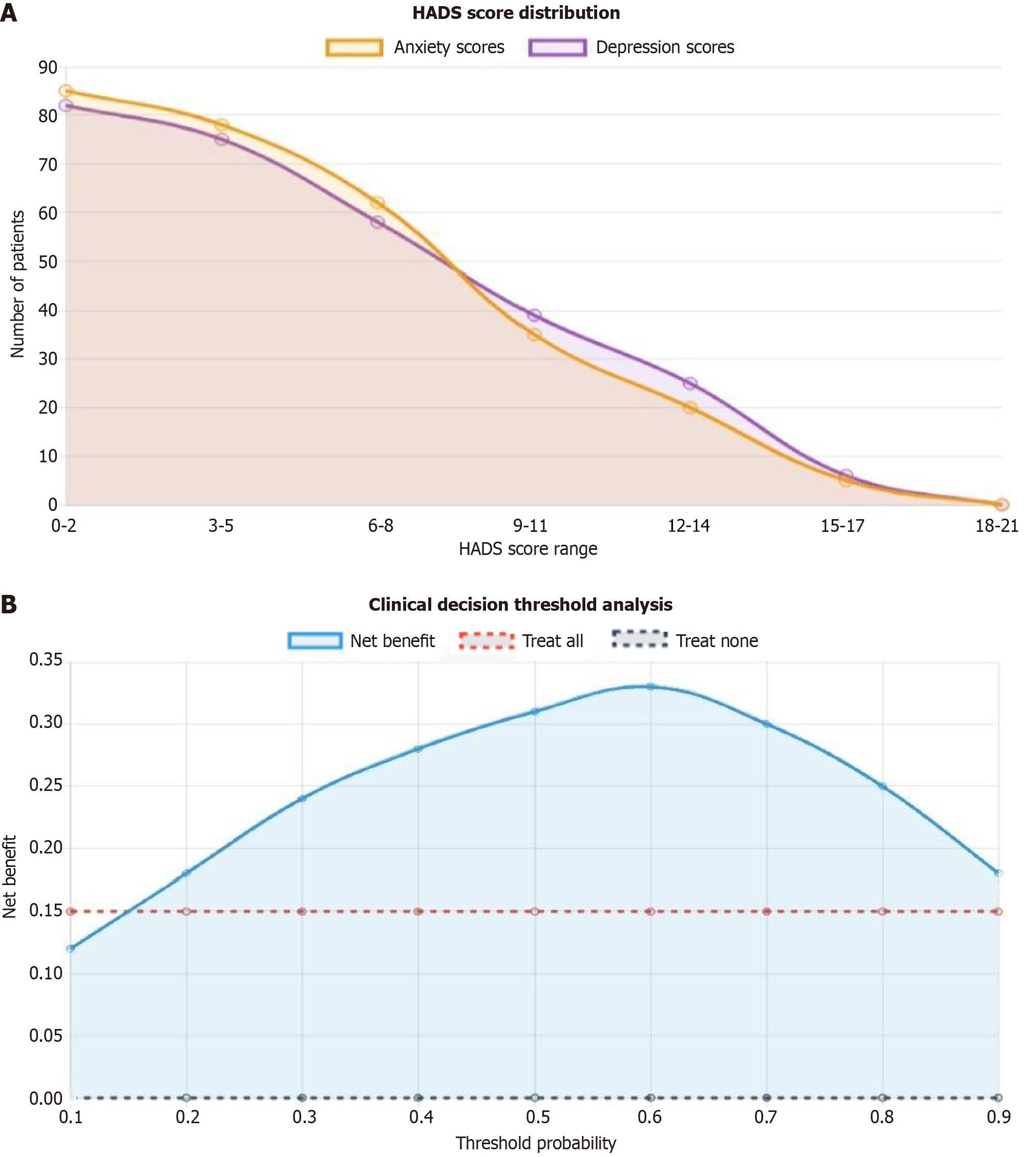
Figure 1 Hospital Anxiety and Depression Scale score distribution and decision curve analysis in breast cancer patients.
A: The figure displays the Hospital Anxiety and Depression Scale score distribution among 285 breast cancer patients. The horizontal axis represents Hospital Anxiety and Depression Scale score intervals (ranging from 0-2 points to 18-21 points), while the vertical axis shows the number of patients. The orange line represents the anxiety score distribution, and the purple line represents the depression score distribution. Both curves exhibit right-skewed distribution characteristics, with the majority of patients’ anxiety and depression scores concentrated in the lower score range (0-8 points), and the number of patients gradually decreases as scores increase; B: This figure demonstrates the clinical decision threshold analysis for predicting psychological morbidity in breast cancer patients based on family dysfunction. The horizontal axis represents threshold probabilities (0.1-0.9), and the vertical axis represents net benefit values. The blue solid line represents the net benefit curve of the prediction model, which peaks at approximately threshold probability 0.6 (net benefit approximately 0.33), indicating this threshold as the optimal decision point. HADS: Hospital Anxiety and Depression Scale.
- Citation: Li ZJ, Chen LY, Zhuang XF, Yang PP, Fang Y. Predictive role of family dysfunction on psychological morbidity in breast cancer patients. World J Psychiatry 2026; 16(2): 113887
- URL: https://www.wjgnet.com/2220-3206/full/v16/i2/113887.htm
- DOI: https://dx.doi.org/10.5498/wjp.v16.i2.113887