
















©2010 Baishideng Publishing Group Co.
World J Radiol. Jun 28, 2010; 2(6): 230-232
Published online Jun 28, 2010. doi: 10.4329/wjr.v2.i6.230
Published online Jun 28, 2010. doi: 10.4329/wjr.v2.i6.230
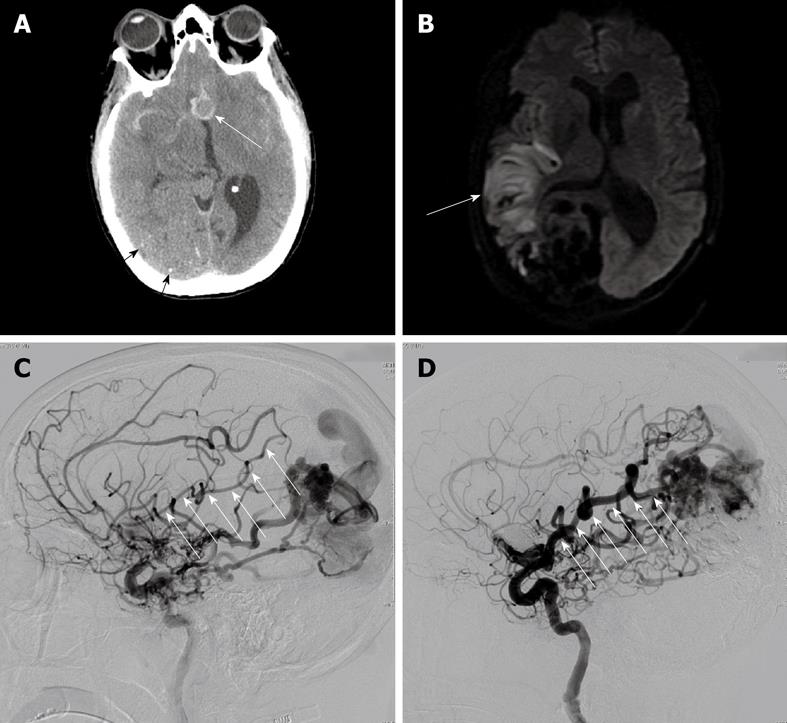
Figure 1 A 47-year-old woman with ruptured anterior communicating artery aneurysm associated with a large arteriovenous malformation.
A: Computed tomography brain scan shows the 12 mm anterior communicating artery aneurysm in relief surrounded by high-density subarachnoid hemorrhage (white arrow). Also note small stippled calcifications in the large parietal-occipital arteriovenous malformation (black arrows); B: Diffusion-weighted magnetic resonance imaging shows area of restricted diffusion in the posterior right frontal lobe (white arrow) corresponding with the patient’s left-sided weakness and hemi-neglect; C: Catheter arteriography of the right internal carotid artery in the lateral projection at the time of initial presentation approximately 1 wk following subarachnoid hemorrhage shows significant narrowing in the angular and Rolandic branches of the right middle cerebral artery, both of which supply the arteriovenous malformation (white arrows); D: Catheter arteriography of the right internal carotid artery in the lateral projection 4 mo after initial presentation and following complete neurological recovery shows resolution of vasospasm in the angular and parietal branches of the right middle cerebral artery supplying the arteriovenous malformation (white arrows).
- Citation: Alexander MD, Connolly ES, Meyers PM. Revisiting normal perfusion pressure breakthrough in light of hemorrhage-induced vasospasm. World J Radiol 2010; 2(6): 230-232
- URL: https://www.wjgnet.com/1949-8470/full/v2/i6/230.htm
- DOI: https://dx.doi.org/10.4329/wjr.v2.i6.230