
















Copyright: ©Author(s) 2026.
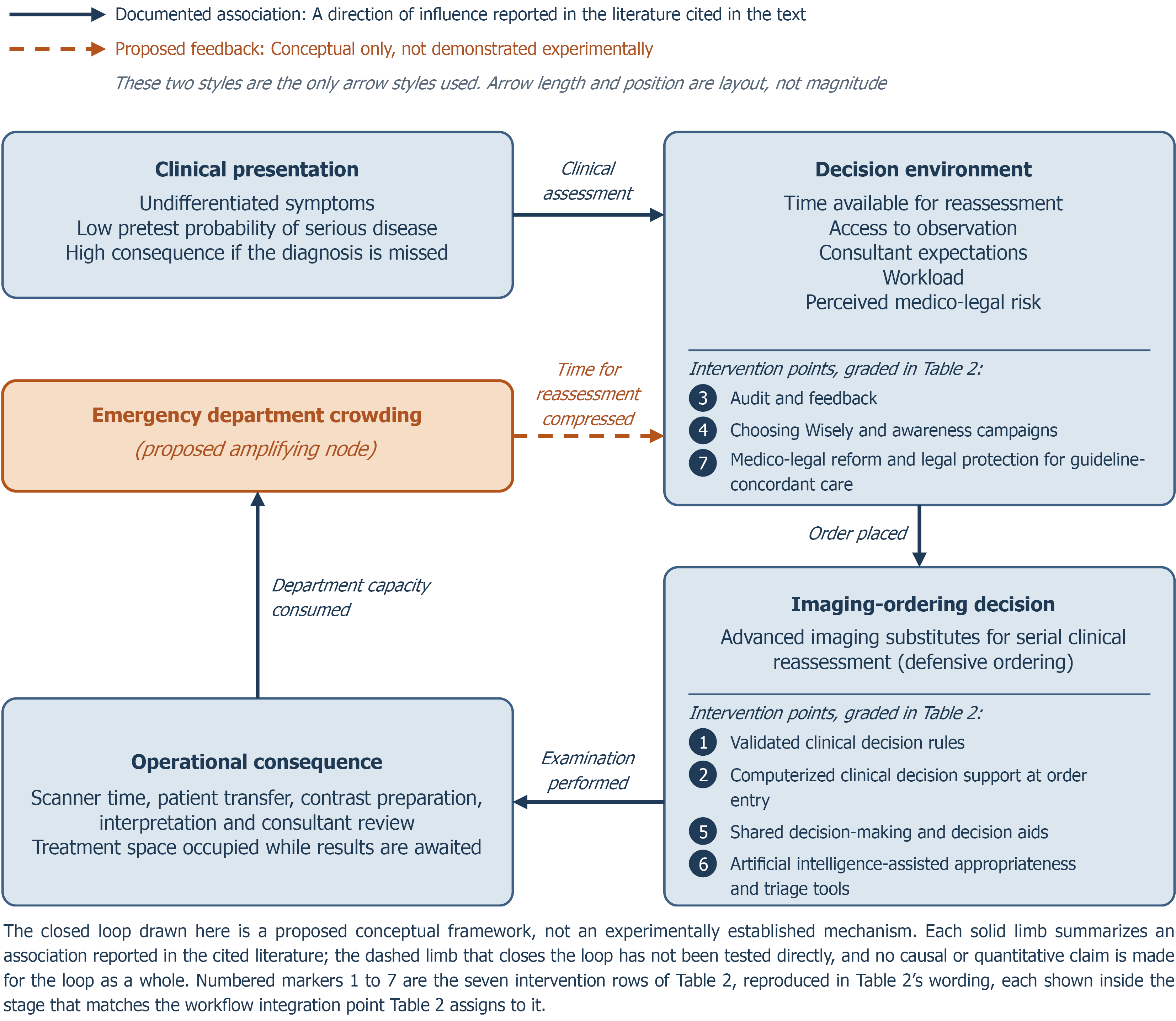
Figure 1 Proposed reciprocal-pressure framework linking defensive advanced imaging and emergency department crowding.
This figure is a line schematic and not a generated image: Its boxes, arrows, text and geometry were each specified explicitly in a drawing script, and that script was written with the assistance of a general-purpose artificial intelligence assistant. Every word printed in the figure comes from the manuscript text or from Table 2. The four rounded boxes follow a single patient episode: An undifferentiated clinical presentation, the decision environment in which the clinician works, the imaging-ordering decision, and its operational consequence for the department. Two arrow styles are used and no others. A solid navy arrow marks a documented association, that is, a direction of influence reported in the literature cited in the text. A dashed orange arrow marks the proposed feedback limb, which is conceptual only and has not been demonstrated experimentally. Arrow length and position are matters of layout and carry no quantitative meaning. Emergency department crowding is drawn as a proposed amplifying node rather than as a stage of the episode, because the limb that returns from crowding to the decision environment is the part of the loop that has not been tested directly. Taken as a whole, the closed loop is a proposed conceptual framework and not an experimentally established mechanism, and no causal or quantitative claim is made for it. The numbered markers 1 to 7 inside the “Decision environment” and “Imaging-ordering decision” boxes are the seven intervention rows of Table 2, reproduced in the wording of Table 2, and each marker is placed inside the stage that matches the workflow integration point Table 2 assigns to that intervention: 1: Validated clinical decision rules; 2: Computerized clinical decision support at order entry; 3: Audit and feedback; 4: Choosing Wisely and awareness campaigns; 5: Shared decision-making and decision aids; 6: Artificial intelligence-assisted appropriateness and triage tools; 7: Medico-legal reform and legal protection for guideline-concordant care. Table 2 gives the strength of evidence, stakeholders, monitoring metrics and potential unintended consequences for each of these seven interventions.
- Citation: Kudu E, Hizli N, Danış F, Altun M. Defensive medicine and advanced imaging overuse in emergency departments: A focused review of imaging stewardship and overcrowding. World J Radiol 2026; 18(10): 127912
- URL: https://www.wjgnet.com/1949-8470/full/v18/i10/127912.htm
- DOI: https://dx.doi.org/10.4329/wjr.127912