
















Copyright: ©Author(s) 2026.
World J Biol Chem. Jun 5, 2026; 17(2): 121467
Published online Jun 5, 2026. doi: 10.4331/wjbc.v17.i2.121467
Published online Jun 5, 2026. doi: 10.4331/wjbc.v17.i2.121467
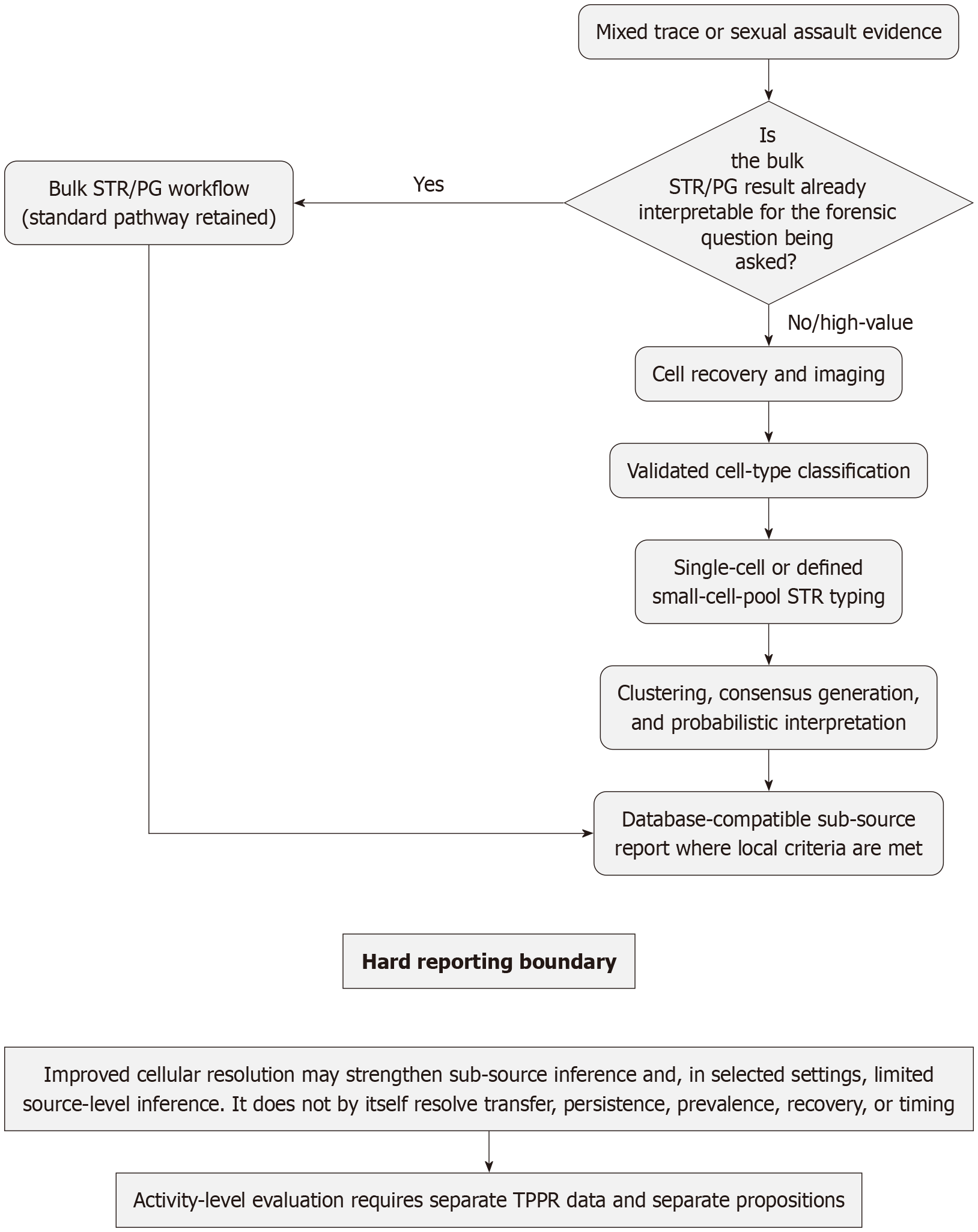
Figure 1 Proposed one-panel schematic for the translational logic of single-cell and single-molecule analysis for deoxyribonucleic acid identification-like workflows.
Bulk short tandem repeat (STR)/probabilistic genotyping should be retained when it already answers the forensic question. In non-interpretable or high-value cases, a cell-resolved workflow may proceed through cell recovery and imaging, validated cell-type classification, single-cell or small-cell-pool STR typing, and clustering/consensus-based probabilistic interpretation, with database-compatible sub-source reporting where local criteria are met. A hard reporting boundary remains: Cellular resolution alone does not resolve transfer, persistence, prevalence, recovery, or timing, and activity-level evaluation requires separate transfer, persistence, prevalence, and recovery data and separate propositions. TPPR: Transfer, persistence, prevalence, and recovery; PG: Probabilistic genotyping; STR: Short tandem repeat.
- Citation: Evangelou K, Angeli P, Polydorou A, Petropoulou T. Single-cell deoxyribonucleic acid typing for forensic mixtures and trace evidence: Opportunities, validation requirements, and reporting limits. World J Biol Chem 2026; 17(2): 121467
- URL: https://www.wjgnet.com/1949-8454/full/v17/i2/121467.htm
- DOI: https://dx.doi.org/10.4331/wjbc.v17.i2.121467