
















Copyright: ©Author(s) 2027.
World J Gastroenterol. Jan 14, 2027; 33(2): 125931
Published online Jan 14, 2027. doi: 10.3748/wjg.125931
Published online Jan 14, 2027. doi: 10.3748/wjg.125931
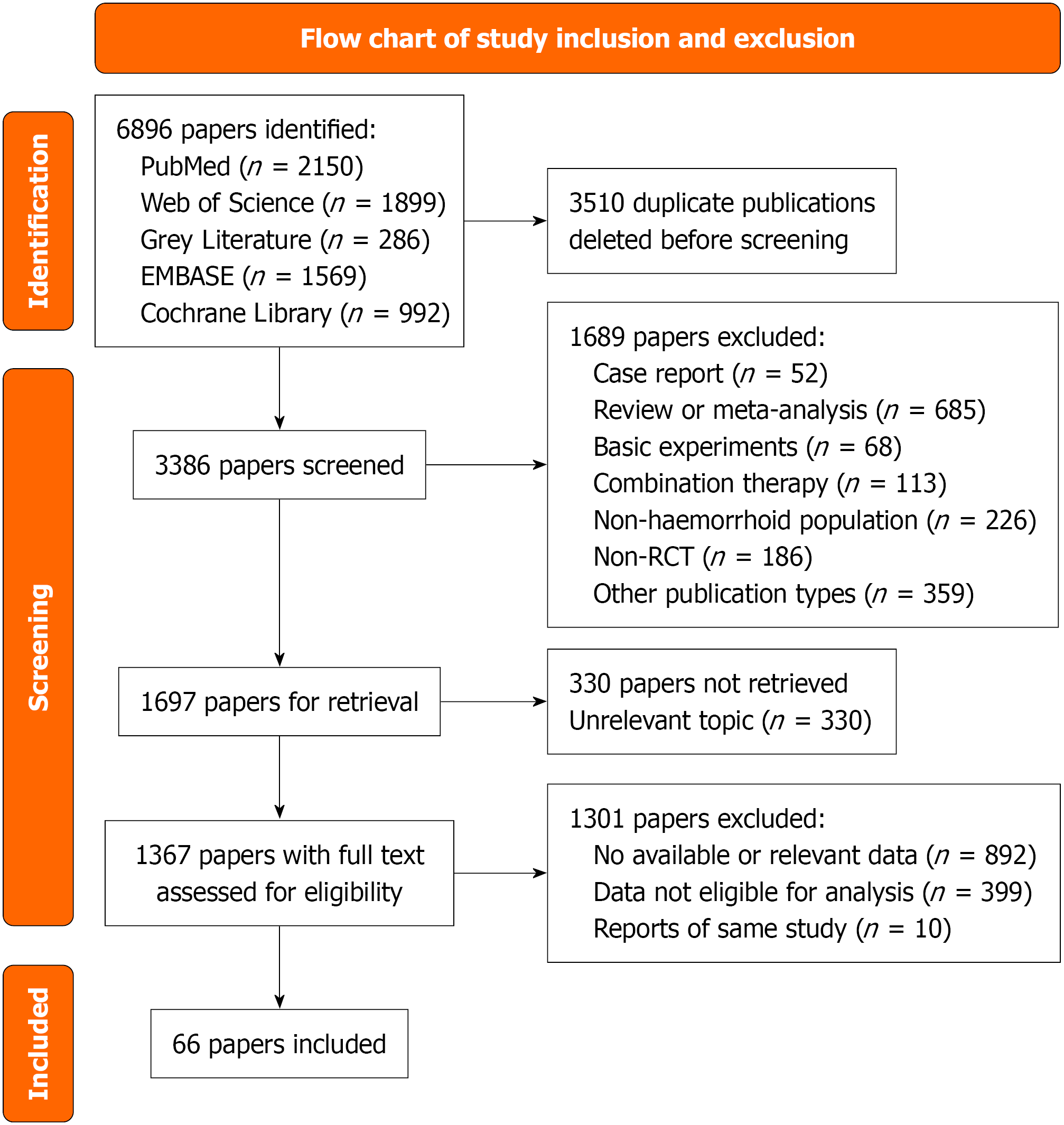
Figure 1 Study selection flow diagram.
The flow diagram illustrates the identification, screening, eligibility assessment, and inclusion of studies in the network meta-analysis. Of the 6896 records initially identified through database searches and other sources, 66 randomized controlled trials met the eligibility criteria and were included in the quantitative synthesis. RCT: Randomized controlled trial.
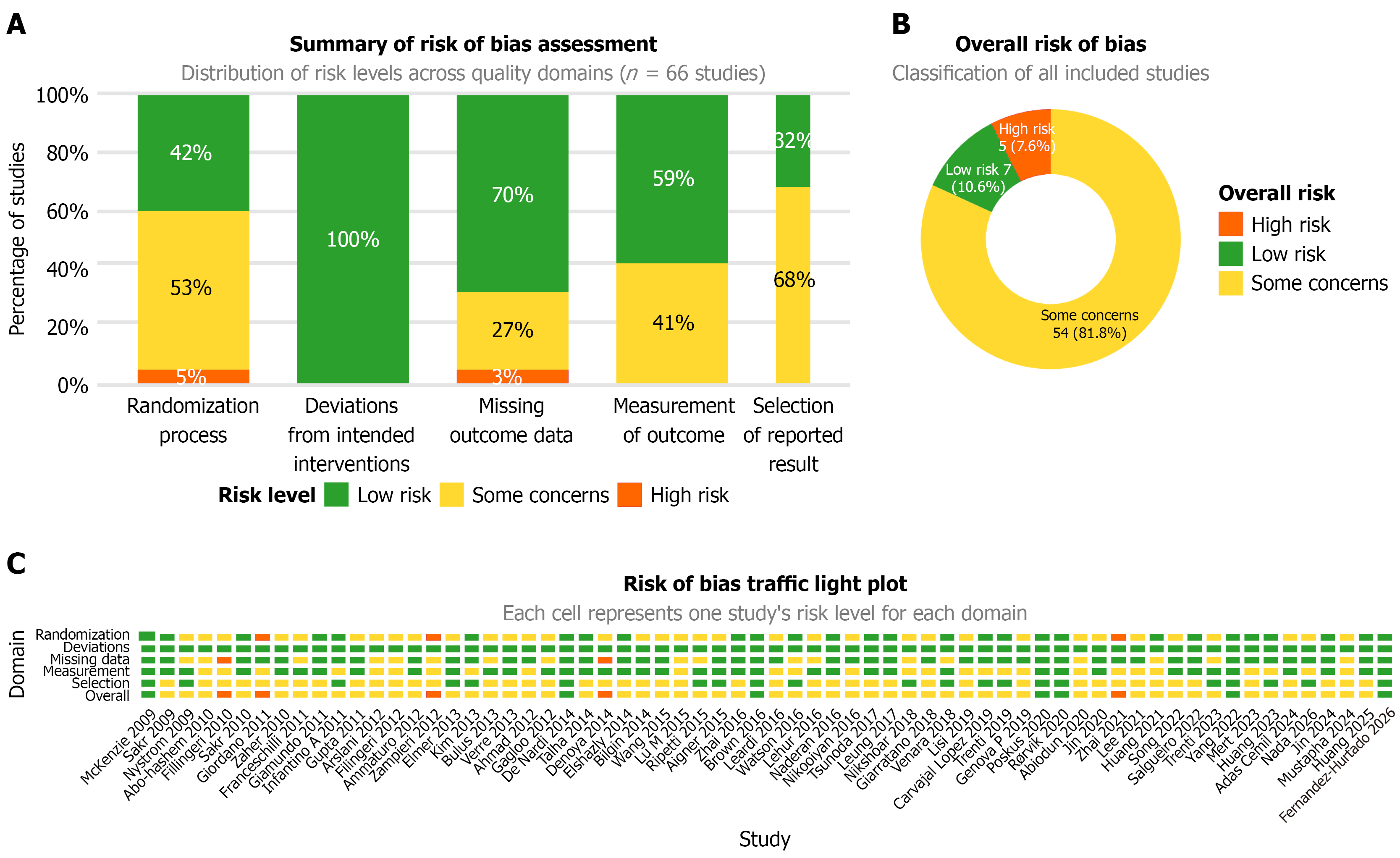
Figure 2 Risk-of-bias assessment.
A: Risk-of-bias assessments for the 66 included randomized controlled trials, showing the proportion of studies rated as “low risk,” “some concerns,” or “high risk” for each of the 5 Risk of Bias 2.0 domains: Randomization process, deviations from intended interventions, missing outcome data, outcome measurement, and selective reporting; B: Overall risk-of-bias judgment for the included studies, categorized as low risk, some concerns, or high risk; C: Traffic light plot providing a study-by-study visualization of domain-level judgments (green = low risk; yellow = some concerns; orange = high risk). The majority of studies (81.8%) were rated as having some concerns regarding risk of bias; 5 studies (7.6%) were rated as high risk, primarily due to inadequate randomization methods or substantial loss to follow-up.
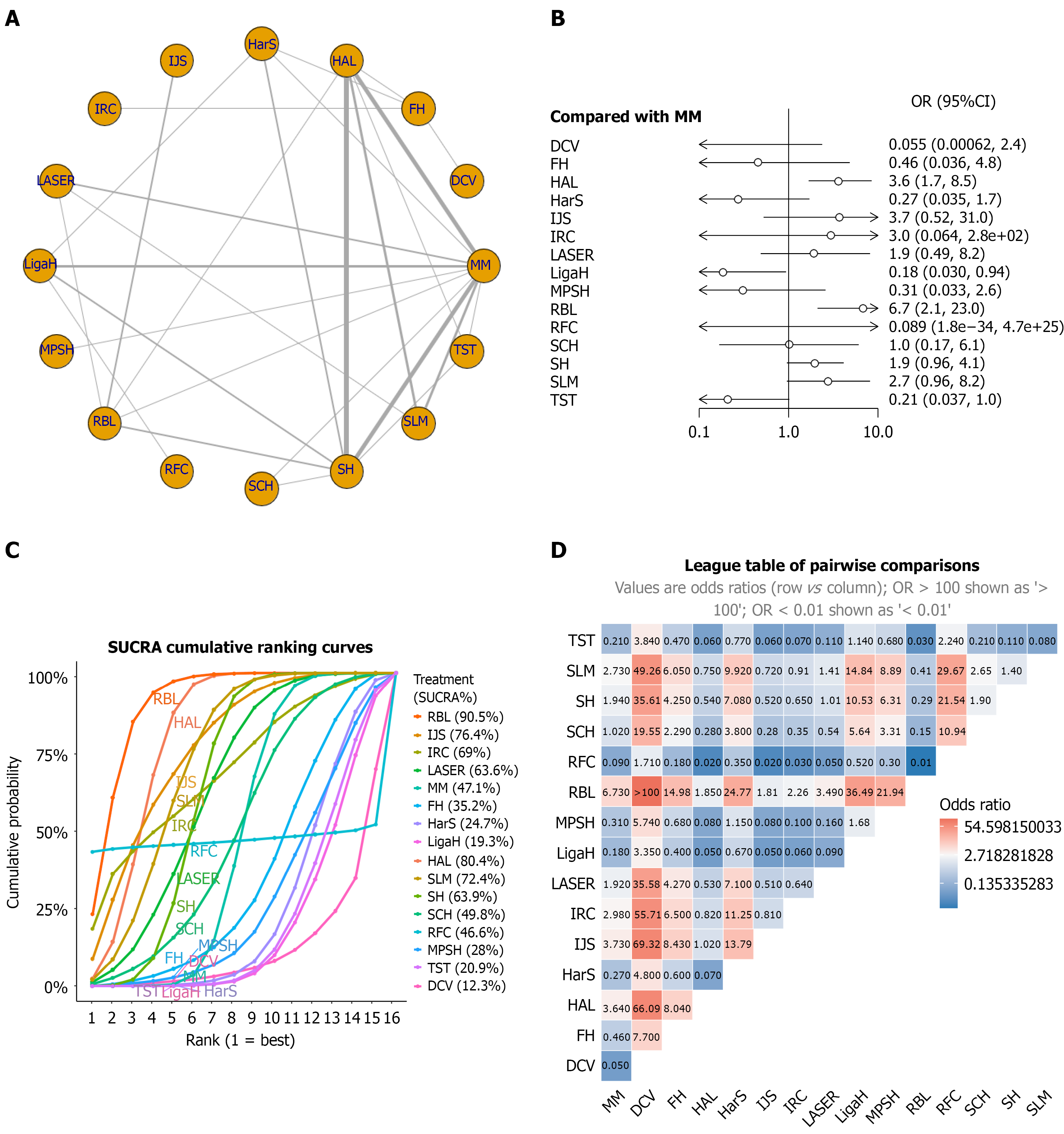
Figure 3 Network meta-analysis results for recurrence.
A: Network geometry of the evidence for recurrence, with node size proportional to the number of patients and edge width proportional to the number of direct comparisons; B: Forest plot of odds ratios for recurrence, with Milligan–Morgan hemorrhoidectomy as the reference; C: Surface under the cumulative ranking curve values for recurrence (higher values indicate a greater probability of being the most recurrence-prone intervention); D: League table of pairwise comparisons, showing odds ratios and 95% credible intervals for recurrence. 95%CI: 95% credible interval; DCV: Direct current electrotherapy; FH: Ferguson hemorrhoidectomy; HAL: Hemorrhoidal artery ligation; HarS: Harmonic scalpel hemorrhoidectomy; IJS: Injection sclerotherapy; IRC: Infrared coagulation; LASER: Laser hemorrhoidectomy; LigaH: LigaSure™ hemorrhoidectomy; MM: Milligan–Morgan hemorrhoidectomy; MPSH: Modified Park’s submucosal hemorrhoidectomy; OR: Odds ratio; RBL: Rubber band ligation; RFC: Radiofrequency coagulation; SCH: Semi-closed hemorrhoidectomy; SH: Stapled hemorrhoidopexy; SLM: Suture ligation with mucopexy; TST: Tissue-selecting technique.
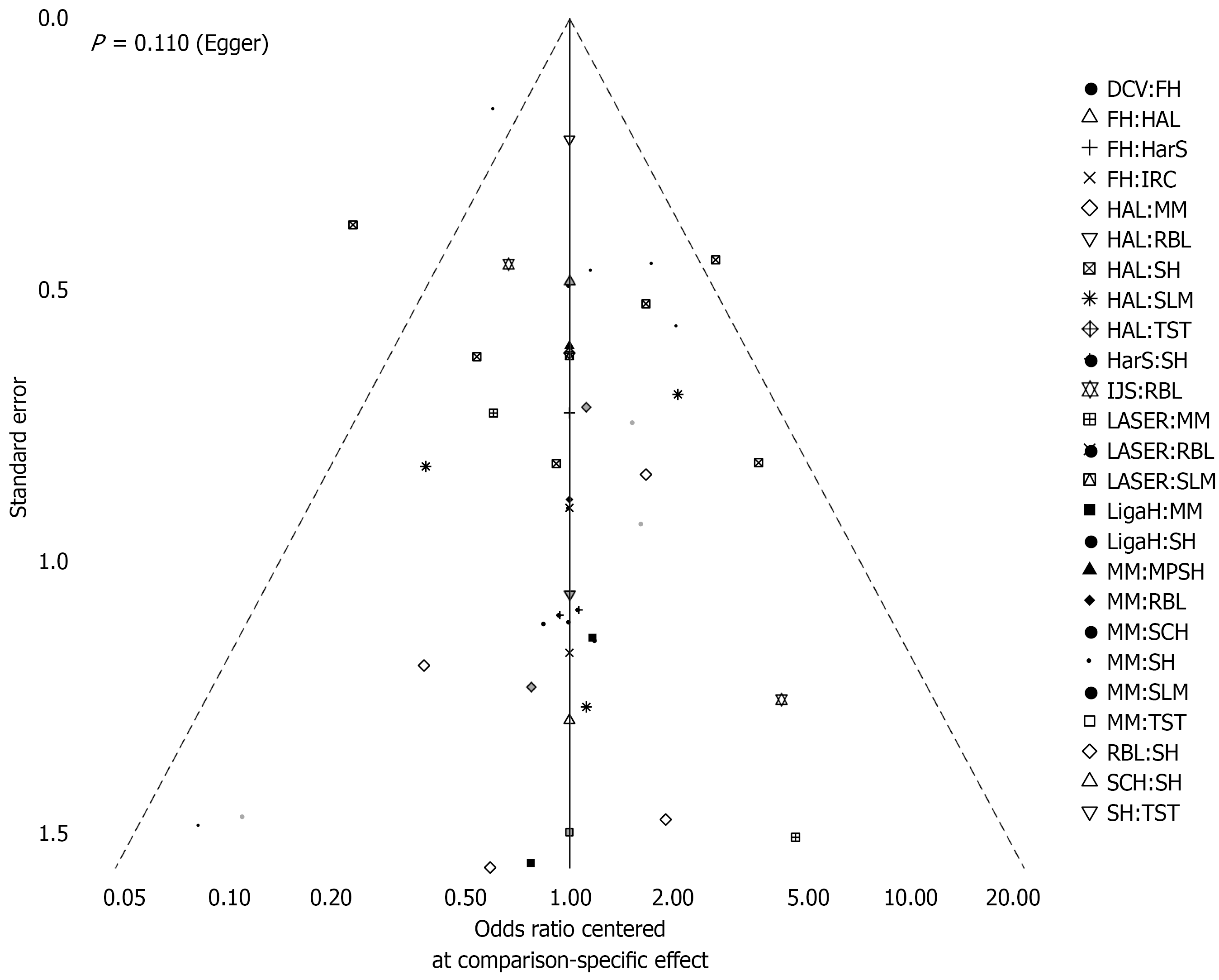
Figure 4 Comparison-adjusted funnel plot for publication bias.
A comparison-adjusted funnel plot is shown for the recurrence outcome in the network meta-analysis. Each point represents a direct pairwise comparison, with the effect estimate plotted against its standard error. A roughly symmetrical distribution around the overall summary effect is observed, with no overt asymmetry. Egger’s test yielded a P value of 0.110, indicating no statistically significant evidence of publication bias. DCV: Direct current electrotherapy; FH: Ferguson hemorrhoidectomy; HAL: Hemorrhoidal artery ligation; HarS: Harmonic scalpel hemorrhoidectomy; IJS: Injection sclerotherapy; IRC: Infrared coagulation; LASER: Laser hemorrhoidectomy; LigaH: LigaSure™ hemorrhoidectomy; MM: Milligan–Morgan hemorrhoidectomy; MPSH: Modified Park’s submucosal hemorrhoidectomy; RBL: Rubber band ligation; SCH: Semi-closed hemorrhoidectomy; SH: Stapled hemorrhoidopexy; SLM: Suture ligation with mucopexy; TST: Tissue-selecting technique.
- Citation: Chen B, Xiong XR, Zhang ZG, Chen QQ. Comparison of efficacy and safety of different treatment modalities for hemorrhoids: A network meta-analysis. World J Gastroenterol 2027; 33(2): 125931
- URL: https://www.wjgnet.com/1007-9327/full/v33/i2/125931.htm
- DOI: https://dx.doi.org/10.3748/wjg.125931