










BPG is committed to discovery and dissemination of knowledge
Review
Copyright ©The Author(s) 2026.
World J Gastroenterol. Jan 7, 2026; 32(1): 114558
Published online Jan 7, 2026. doi: 10.3748/wjg.v32.i1.114558
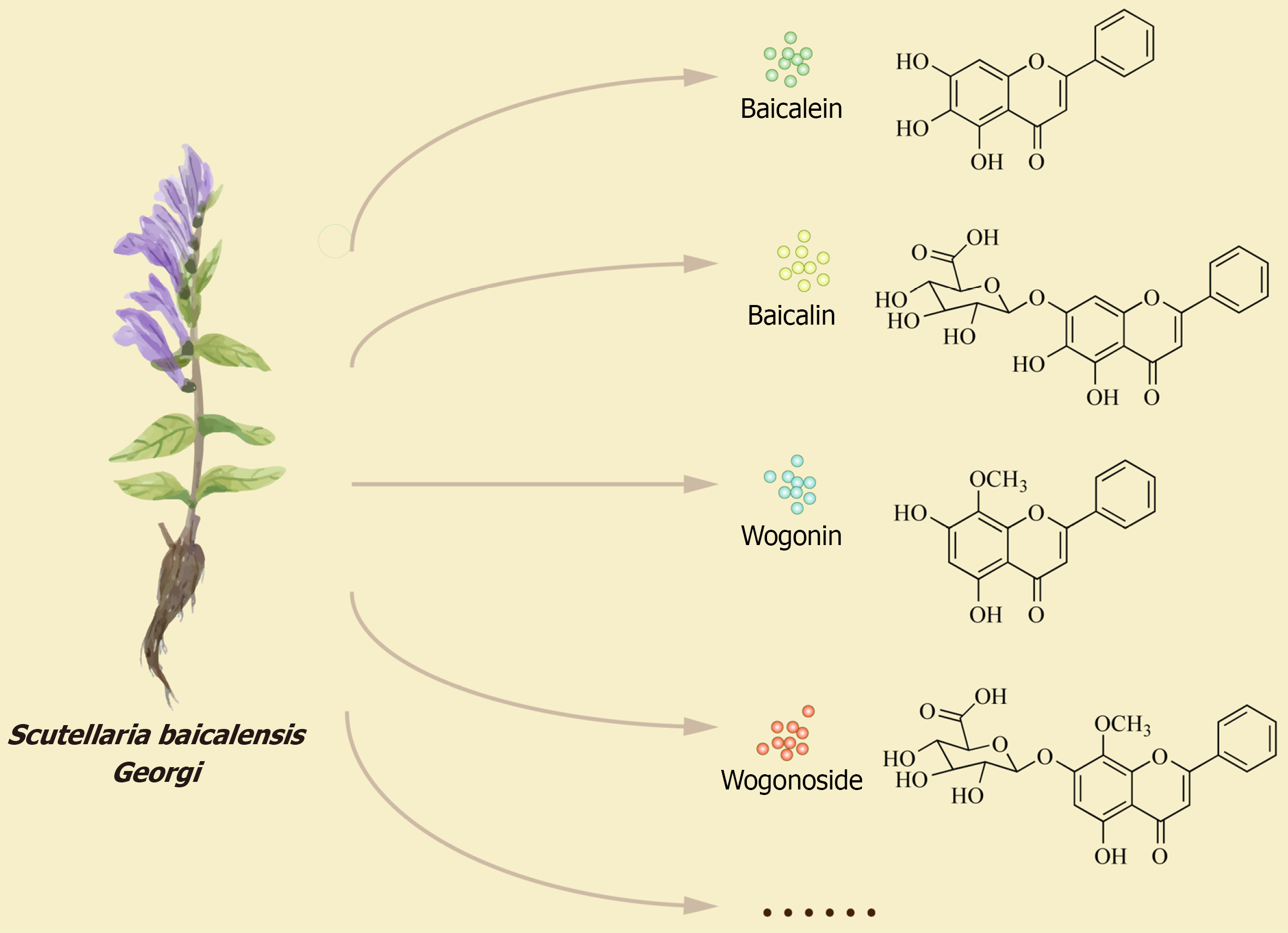
Figure 1
Figure 1 The important active ingredients of Scutellaria baicalensis Georgi (Huangqin). Scutellaria baicalensis Georgi (Huangqin), the dried root of Scutellaria L. (family Labiaceae), contains 132 compounds. Among these, baicalein, baicalin, wogonin, and wogonoside are recognized as the principal active components responsible for its anti-inflammatory effects.
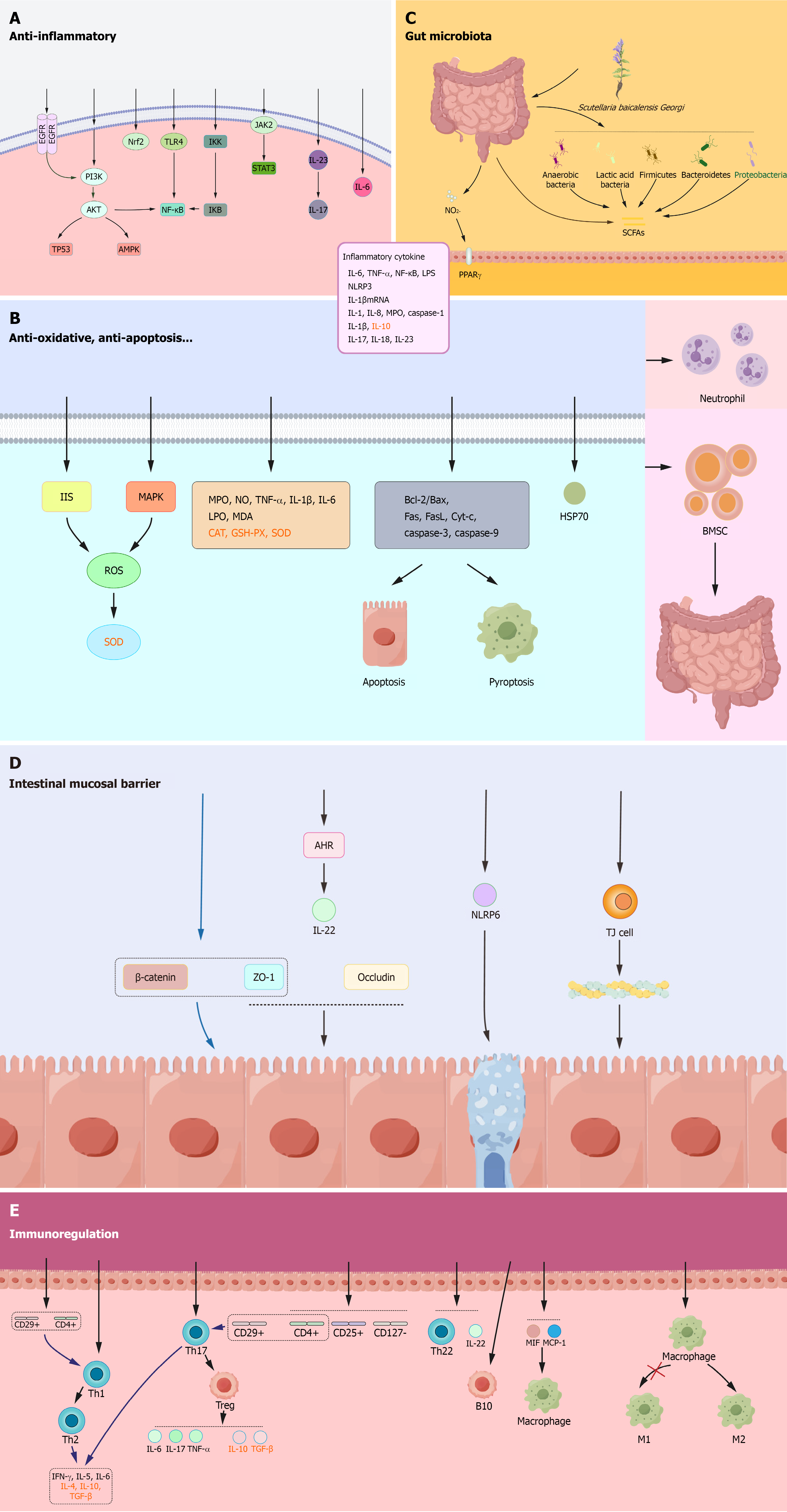
Figure 2
Figure 2 The mechanism of action of Scutellaria baicalensis Georgi (Huangqin) on ulcerative colitis. A: Anti-inflammatory effects, including inhibition of inflammatory signaling pathways [epidermal growth factor receptor (EGFR)-phosphatidylinositol 3-kinase (PI3K)/protein kinase B (AKT)/nuclear factor-κB, EGFR/PI3K/AKT/tumor protein 53, and EGFR/PI3K/AKT/mitogen-activated protein kinase] and reducing pro-inflammatory cytokines [tumor necrosis factor-α, interleukin (IL)-1β, IL-8, etc.]; B: Antioxidant, anti-apoptotic and other pathways, reducing reactive oxygen species and nitric oxide, inhibiting colonic epithelial cell apoptosis, elevating heat shock protein 70, attenuating fibrosis in intestinal epithelial cells and colonic myofibroblasts, etc.; C: Modulation of gut microbiota, increasing the abundance of Lactobacillus, Firmicutes and Bacteroidetes, reducing the abundance of Proteobacteria, and promoting the production of short-chain fatty acids, etc.; D: Protection of the intestinal mucosal barrier, promoting the aryl hydrocarbon receptor/IL-22 pathway, increasing the expression of two tight junction proteins (zonula occludens-1 and occludin), reducing intestinal permeability, and restoring tight junctions, etc.; E: Immunomodulation, including modulations of T lymphocytes, B lymphocytes and macrophages. EGFR: Epidermal growth factor receptor; PI3K: Phosphatidylinositol 3-kinase; AKT: Protein kinase B; TP53: Tumor protein 53; AMPK: Adenosine monophosphate-activated protein kinase; Nrf2: Nuclear factor erythroid 2-related factor 2; TLR4: Toll-like receptor 4; NF-κB: Nuclear factor-κB; IKK: IκB kinase; IKB: Inhibitor of κB; JAK2: Janus kinase 2; STAT3: Signal transducer and activator of transcription 3; IL: Interleukin; TNF-α: Tumor necrosis factor α; LPS: Lipopolysaccharide; NLRP3: NOD-like receptor pyrin domain-containing 3; MPO: Myeloperoxidase; IIS: Insulin/insulin-like growth factor signaling; MAPK: Mitogen-activated protein kinase; ROS: Reactive oxygen species; SOD: Superoxide dismutase; NO: Nitric oxide; LPO: Lipid peroxidation; MDA: Malondialdehyde; CAT: Catalase; GSH-PX: Glutathione peroxidase; Bcl-1: B-cell lymphoma 1; Bax: Bcl-2-associated X protein; FasL: Fas ligand; Cyt-c: Cytochrome C; BMSC: Bone marrow mesenchymal stem cell; SCFA: Short-chain fatty acid; PPARγ: Peroxisome proliferator-activated receptor γ; ZO-1: Zonula occludens-1; AHR: Aryl hydrocarbon receptor; NLRP6: NOD-like receptor pyrin domain-containing 6; TJ: Tight junction; Th: T helper cell; IFN-γ: Interferon-γ; TGF: Transforming growth factor; Treg: Regulatory T cell; MIF: Macrophage migration inhibitory factor; MCP-1: Monocyte chemoattractant protein-1.