
















©2014 Baishideng Publishing Group Inc.
World J Gastroenterol. Dec 28, 2014; 20(48): 18397-18403
Published online Dec 28, 2014. doi: 10.3748/wjg.v20.i48.18397
Published online Dec 28, 2014. doi: 10.3748/wjg.v20.i48.18397
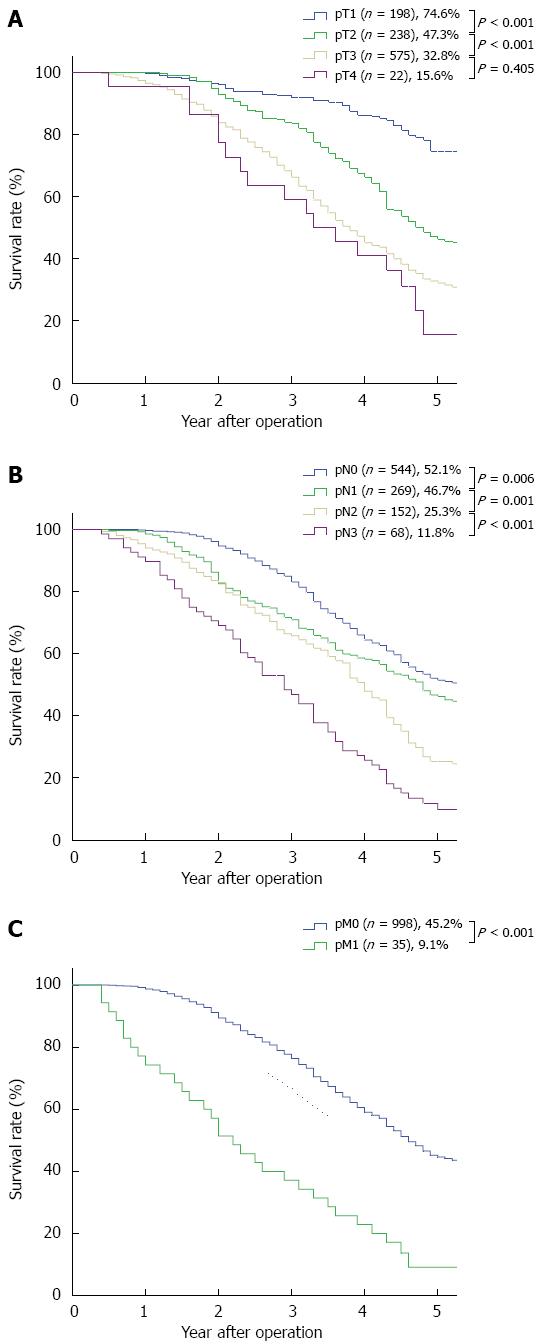
Figure 1 Survival curves of patient subgroups stratified by pT, pN and pM descriptors according to the 7th edition TNM classification.
The 5-year survival rate, the number of patients in each subgroup, and the P-value for comparison between each adjacent subgroup are indicated. A: With respect to the pT descriptor, there were significant differences between each adjacent subgroup except between pT3 and pT4 (P = 0.405); B: With respect to the pN descriptor, there were significant differences between each adjacent subgroup; C: With respect to the pM descriptor, there were significant differences between pM0 and pM1.
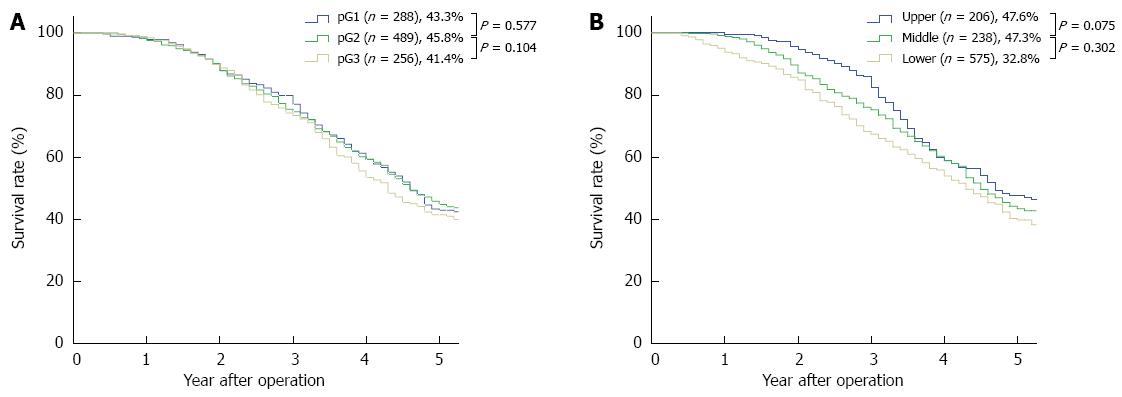
Figure 2 Survival curves for patient subgroups stratified by pG (histologic grade) and cancer location according to the 7th edition TNM classification.
The 5-year survival rate, the number of patients in each subgroup, and the P-value for comparison between each adjacent subgroup are indicated. A: With respect to pG, there was no significant difference between each adjacent pG classification; B: With respect to cancer location, there was no significant difference between each adjacent caner location classification.
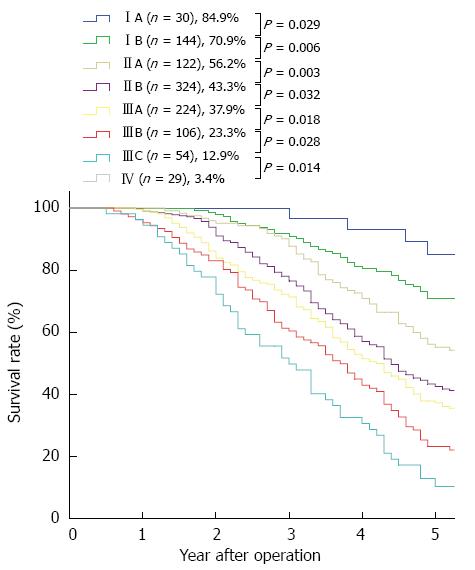
Figure 3 Survival curves for patient subgroups stratified according to the 7th edition TNM pStage groupings.
The 5-year survival rate, the number of patients in each subgroup, and the P-value for comparison between each adjacent subgroup are indicated. The survival curves showed stepwise reduction as the pStage increased, and there were significant differences between each adjacent pStage group.
- Citation: Wang J, Wu N, Zheng QF, Yan S, Lv C, Li SL, Yang Y. Evaluation of the 7th edition of the TNM classification in patients with resected esophageal squamous cell carcinoma. World J Gastroenterol 2014; 20(48): 18397-18403
- URL: https://www.wjgnet.com/1007-9327/full/v20/i48/18397.htm
- DOI: https://dx.doi.org/10.3748/wjg.v20.i48.18397