
















Copyright: ©Author(s) 2026.
World J Cardiol. Nov 26, 2026; 18(11): 126635
Published online Nov 26, 2026. doi: 10.4330/wjc.126635
Published online Nov 26, 2026. doi: 10.4330/wjc.126635
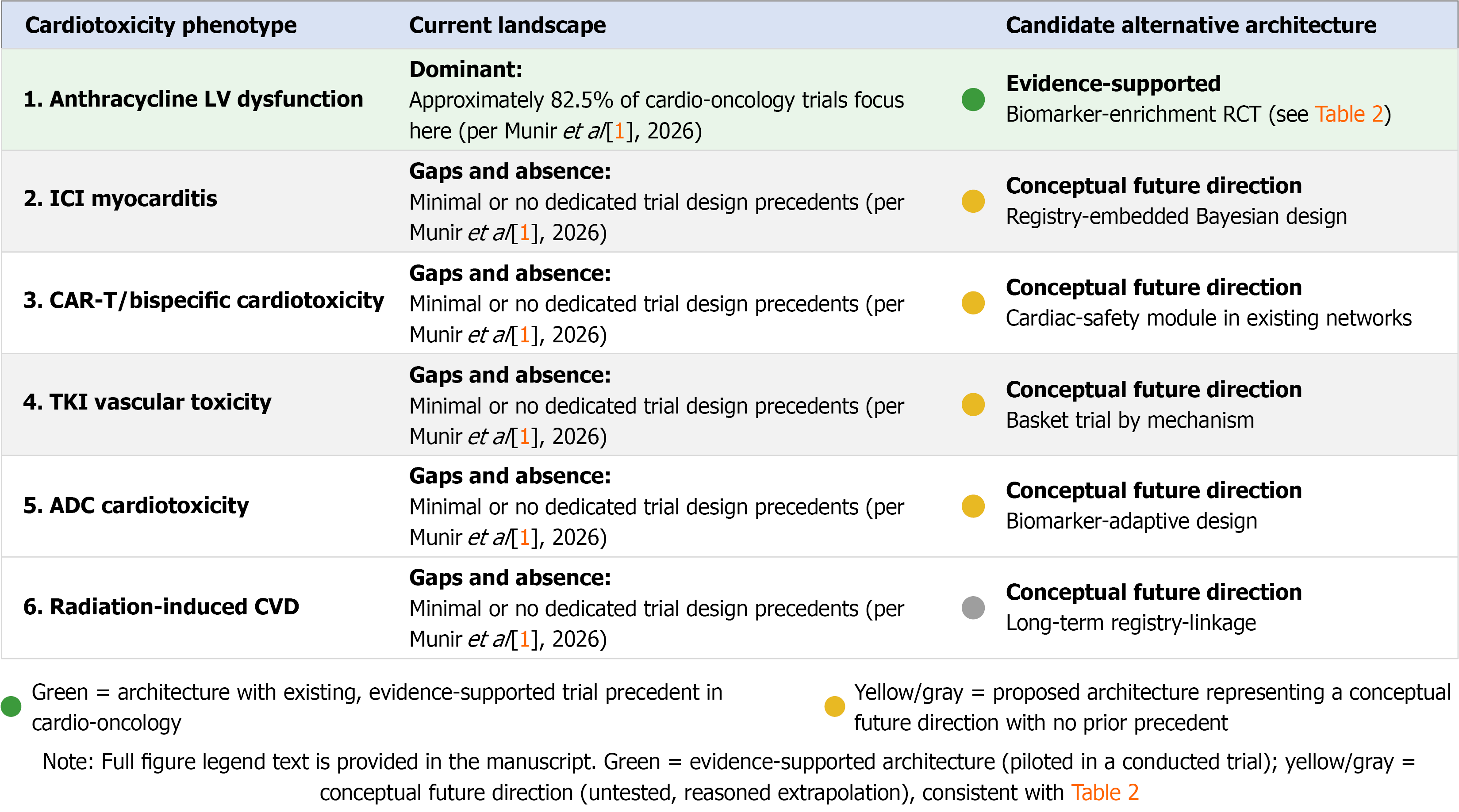
Figure 1 Current trial architecture vs candidate alternatives across six contemporary cardiotoxicity phenotypes.
Green indicates the one phenotype (anthracycline-related left ventricular dysfunction) for which an alternative architecture is evidence-supported. This means only that a trial using that architecture has actually been conducted for this phenotype. It does not mean the cardioprotective intervention is confirmed to work. Yellow/gray indicates the five phenotypes for which the proposed alternative architecture remains a conceptual future direction with no prior precedent. This is an untested, reasoned extrapolation, not a validated or endorsed approach, consistent with the classification in Table 2. Current-landscape percentages are drawn from Munir et al[1]. Precedent gaps reflect the author’s targeted searches (see Limitations). This figure is a conceptual schematic. It was created with Gemini (standard version; Google) on August 7, 2026. The tool was used only to create the visual layout. The author designed the content and checked all text and numbers against Munir et al[1]. RCT: Randomized controlled trial; LV: Left ventricular; ICI: Immune checkpoint inhibitors; TKI: Tyrosine kinase inhibitor; ADC: Antibody-drug conjugates; CVD: Cardiovascular disease.
- Citation: Telli RC. Trial architecture in contemporary cardio-oncology: Why parallel-group randomized controlled trials may not fit every cardiotoxicity phenotype. World J Cardiol 2026; 18(11): 126635
- URL: https://www.wjgnet.com/1949-8462/full/v18/i11/126635.htm
- DOI: https://dx.doi.org/10.4330/wjc.126635