This article is an open-access article which was selected by an in-house editor and fully peer-reviewed by external reviewers. It is distributed in accordance with the Creative Commons Attribution Non Commercial (CC BY-NC 4.0) license, which permits others to distribute, remix, adapt, build upon this work non-commercially, and license their derivative works on different terms, provided the original work is properly cited and the use is non-commercial. See: http://creativecommons.org/licenses/by-nc/4.0/
Jing-Bo Zhang, An Chen, Yu-Zhang Wu, Institute of Immunology of Chinese PLA, Third Military Medical University, Chongqing 400038, China
Shi-Yuan Chen, Ting-Rong Li, Hospital of Infectious Diseases of Chongqing, Chongqing 400030, China
Zhi-Qing Yang, Department of Hepatobiliary Diseases, Southwest Hospital, Third Military Medical University, Chongqing 400038, China
Supported by: the Major State Basic Research Development Program of China (973 Program), No. 2001CB510001; The Major Programs of the National Natural Science Foundation of China, No. 11111111.
Correspondence to: Yu-Zhang Wu, Institute of Immunology of Chinese PLA, Third Military Medical University, Chongqing 400038, China. wuyuzhang@yahoo.com
Received: October 10, 2003 Revised: January 9, 2004 Accepted: February 3, 2004 Published online: May 15, 2004
AIM: To investigate the function state of epitope-specific cytotoxic T lymphocytes (CTLs) in chronic hepatitis B infection
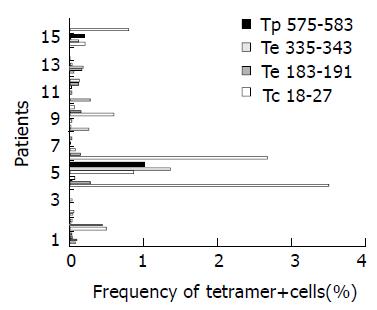
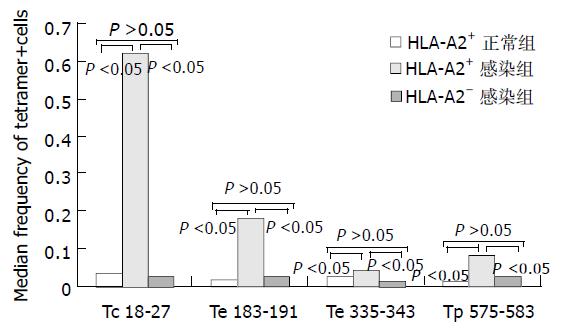
METHODS: The study was performed to quantify the HBV specific CTL directly in vitro by HLA-A2 tetrameric complexes for core 18-27 (Tc 18-27), envelope 183-191 (Te 183-191), envelope 335-343 (Te 335-343), and polymerase 575-583 (Tp 575-583) in active chronic hepatitis patients, and then the correlation of HBV epitope-specific CTL between serum HBV DNA loads or alanine aminotransmerase (ALT) levels were analyzed by multiple regression analysis.
RESULTS: It was found that there were multiple CTLs responses in active chronic hepatitis patients. The frequency of Tc18-27 response was higher than the other three epitope-specific CTLs. No significant correlation was found either between the frequency of HBV specific CD8+ T cells and the viral load, or the frequency of HBV specific CD8+ T cells and the levels of alanine transaminase.
CONCLUSION: The frequencies of HBV-specific T cells are not determinant of immune-mediated protection in HBV infection and the existence of epitope-specific HBV CTLs is not directly correlated to hepatocytic injury.
Key Words: N/A
Citation: Zhang JB, Chen SY, Yang ZQ, Li TR, Chen A, Wu YZ. Comprehensive analysis of the quantity of epitope-specific cytotoxic T lymphocytes in chronic viral hepatitis B infection. Shijie Huaren Xiaohua Zazhi 2004; 12(5): 1069-1072
Guidotti LG. The role of cytotoxic T cells and cytokines in the control of hepatitis B virus infection.Vaccine. 2002;20 Suppl 4:A80-A82.
[PubMed] [DOI]
Appay V, Rowland-Jones SL. The assessment of antigen-specific CD8+ T cells through the combination of MHC class I tetramer and intracellular staining.J Immunol Methods. 2002;268:9-19.
[PubMed] [DOI]
He XS, Rehermann B, Boisvert J, Mumm J, Maecker HT, Roederer M, Wright TL, Maino VC, Davis MM, Greenberg HB. Direct functional analysis of epitope-specific CD8+ T cells in peripheral blood.Viral Immunol. 2001;14:59-69.
[PubMed] [DOI]
Tsai SL, Lee TH, Chien RN, Liao SK, Lin CL, Kuo GC, Liaw YF. A method to increase tetramer staining efficiency of CD8+ T cells with MHC-peptide complexes: therapeutic applications in monitoring cytotoxic T lymphocyte activity during hepatitis B and C treatment.J Immunol Methods. 2004;285:71-87.
[PubMed] [DOI]
Tang TJ, Kwekkeboom J, Laman JD, Niesters HG, Zondervan PE, de Man RA, Schalm SW, Janssen HL. The role of intrahepatic immune effector cells in inflammatory liver injury and viral control during chronic hepatitis B infection.J Viral Hepat. 2003;10:159-167.
[PubMed] [DOI]
Liaw YF. Hepatitis flares and hepatitis B e antigen seroconversion: implication in anti-hepatitis B virus therapy.J Gastroenterol Hepatol. 2003;18:246-252.
[PubMed] [DOI]
Wieland SF, Spangenberg HC, Thimme R, Purcell RH, Chisari FV. Expansion and contraction of the hepatitis B virus transcriptional template in infected chimpanzees.Proc Natl Acad Sci USA. 2004;101:2129-2134.
[PubMed] [DOI]
Appay V, Dunbar PR, Callan M, Klenerman P, Gillespie GM, Papagno L, Ogg GS, King A, Lechner F, Spina CA. Memory CD8+ T cells vary in differentiation phenotype in different persistent virus infections.Nat Med. 2002;8:379-385.
[PubMed] [DOI]
Kakimi K, Isogawa M, Chung J, Sette A, Chisari FV. Immunogenicity and tolerogenicity of hepatitis B virus structural and nonstructural proteins: implications for immunotherapy of persistent viral infections.J Virol. 2002;76:8609-8620.
[PubMed] [DOI]
Yang PL, Althage A, Chung J, Chisari FV. Hydrodynamic injection of viral DNA: a mouse model of acute hepatitis B virus infection.Proc Natl Acad Sci USA. 2002;99:13825-13830.
[PubMed] [DOI]
Reignat S, Webster GJ, Brown D, Ogg GS, King A, Seneviratne SL, Dusheiko G, Williams R, Maini MK, Bertoletti A. Escaping high viral load exhaustion: CD8 cells with altered tetramer binding in chronic hepatitis B virus infection.J Exp Med. 2002;195:1089-1101.
[PubMed] [DOI]
Webster G, Bertoletti A. Quantity and quality of virus-specific CD8 cell response: relevance to the design of a therapeutic vaccine for chronic HBV infection.Mol Immunol. 2001;38:467-473.
[PubMed] [DOI]
Boni C, Penna A, Ogg GS, Bertoletti A, Pilli M, Cavallo C, Cavalli A, Urbani S, Boehme R, Panebianco R. Lamivudine treatment can overcome cytotoxic T-cell hyporesponsiveness in chronic hepatitis B: new perspectives for immune therapy.Hepatology. 2001;33:963-971.
[PubMed] [DOI]
Addo MM, Yu XG, Rathod A, Cohen D, Eldridge RL, Strick D, Johnston MN, Corcoran C, Wurcel AG, Fitzpatrick CA. Comprehensive epitope analysis of human immunodeficiency virus type 1 (HIV-1)-specific T-cell responses directed against the entire expressed HIV-1 genome demonstrate broadly directed responses, but no correlation to viral load.J Virol. 2003;77:2081-2092.
[PubMed] [DOI]
Perrillo RP, Lai CL, Liaw YF, Dienstag JL, Schiff ER, Schalm SW, Heathcote EJ, Brown NA, Atkins M, Woessner M. Predictors of HBeAg loss after lamivudine treatment for chronic hepatitis B.Hepatology. 2002;36:186-194.
[PubMed] [DOI]
Guidotti LG, Chisari FV. Noncytolytic control of viral infections by the innate and adaptive immune response.Annu Rev Immunol. 2001;19:65-91.
[PubMed] [DOI]
Sitia G, Isogawa M, Kakimi K, Wieland SF, Chisari FV, Guidotti LG. Depletion of neutrophils blocks the recruitment of antigen-nonspecific cells into the liver without affecting the antiviral activity of hepatitis B virus-specific cytotoxic T lymphocytes.Proc Natl Acad Sci USA. 2002;99:13717-13722.
[PubMed] [DOI]
Kakimi K, Lane TE, Wieland S, Asensio VC, Campbell IL, Chisari FV, Guidotti LG. Blocking chemokine responsive to gamma-2/interferon (IFN)-gamma inducible protein and monokine induced by IFN-gamma activity in vivo reduces the pathogenetic but not the antiviral potential of hepatitis B virus-specific cytotoxic T lymphocytes.J Exp Med. 2001;194:1755-1766.
[PubMed] [DOI]
Kakimi K, Lane TE, Chisari FV, Guidotti LG. Cutting edge: Inhibition of hepatitis B virus replication by activated NK T cells does not require inflammatory cell recruitment to the liver.J Immunol. 2001;167:6701-6705.
[PubMed] [DOI]